Showing posts with label Territorial Army. Show all posts

Friday, 14 November 2014

Marching to the sound of the guns.

The Queen's Westminster Rifles had been told as recently as October that they would not be expected to go to France until the Spring of 1915.

The regular Army had been suffering appalling casualties ever since the initial action at Mons, but remained unwilling to accept that they must call on the Territorial Army units training in Great Britain.  By the middle of October 1914 the situation had become so bad, that at very short notice the first units were called out to France.  The sector around Armentieres was seen as a "quiet sector"  suitable for these untried units.

Lord French had however to accept that he must use Territorial units if he was to prevent the line from breaking. He decided that although the Queen's Westminsters and the 8th Royal Scots had only arrived on the 1st and 8th of November respectively, yet their condition was so good that they were able to be sent to the front immediately after the H.A.C.[1]


John Baber, in his final days at Cambridge in the dark suit and cap,
his mother Clara is in the centre in a dark outfit and hat,
Frances, John's elder sister, also in a dark outfit stands to the left. The photograph
was taken at during the May Week on Wednesday 10th June 1914 at the grandstand
for the Bumps Race. Later that month events in Sarajevo would wreck their World
along with all those others there.

John wrote very differently to his sister than he did to his parents. This is demonstrated by the following letter, written describing his thoughts as the order came in to go to the front for the very first time.  As he would continue to do throughout much of the war he wrote in a light hearted way for his sister.
The letter can only be dated from the postmark on the envelope.  The letter is written in indelible pencil as required by orders.  The letter has been signed by Colonel Shoolbred on the reverse to show that it has been censored.


Mother’s and Dad’s letters of the
4th have just arrived.  I was glad to get them.
The parcel has not turned up
As yet, but I expect it will
Do so shortly.
Please congratulate Harold Willcock’s [2] folk for me.
It is rather odd that I know
4 men who figure in that list.
News just come that
We are moving up to the trenches at 8AM tomorrow.
Poor old Pat [3] has been done
In the eye after all!  By the time this reaches you I shall
Probably have been
Fighting almost a week.
Isn’t it a splendid compliment
To the Regiment.
I suppose I ought not to say that.


Page 2,

We have all been
Ordered by all sorts of officers of
Senior rank to keep our heads,
Down, so will take no risks.
Am to hungry to write more.
Love to all

John.

Ray [4] is fit as a fiddle
& in fine form.

Later  Parcel just come
Thanks most awfully
Only just in time.


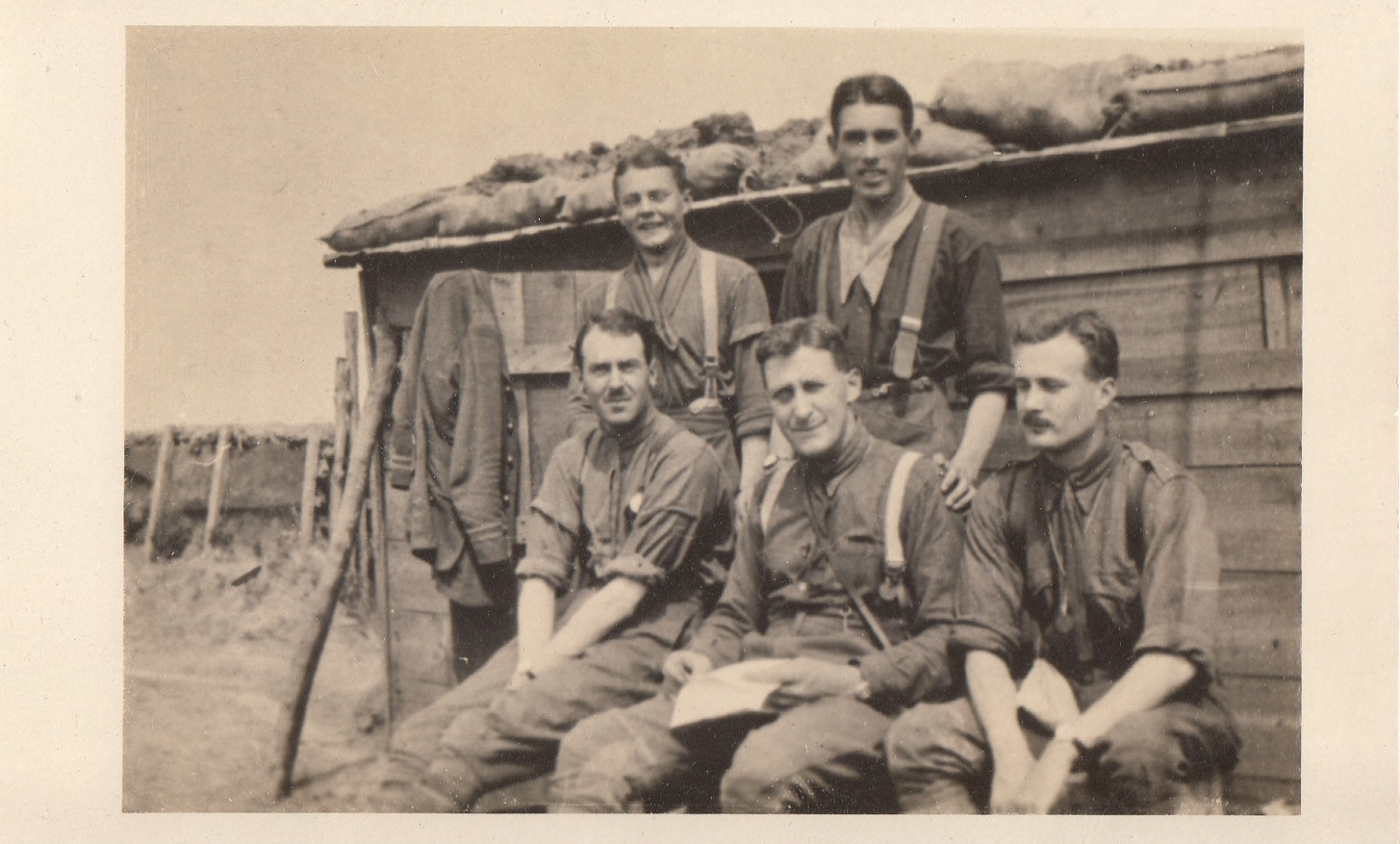
Officers from A Company.

Barwell, Dickinson
Savill Jones and Green.
 
 
The photograph is taken outside one of the huts built at Houplines into the mud and timber barricades built over the low lying valley between Houplines and the German lines.

2nd Lieutenant Ray Dickinson, the son of Lady Dickinson, mentioned in the letter above was well known to both John and Frances Baber, as he had been brought up at 6 Phillimore Gardens, very near to 9 Phillimore Gardens where John's parents lived in Kensington.  Ray had volunteered for the battalion in the very first days of the war.  He was close to my grandmother and may have been her boyfriend.  She remained in contact with Ray's sisters long after Ray had been killed on the October 2nd 1915, by when he had become Captain in command of the Company. Ray was one of John's great friends in the battalion, and they planned to take their leaves together. He features in many of John's letters.

Lieutenant RS Savill would remain with the regiment for many years, becoming the Commanding Officer and returning the final Cadre to Regimental Headquarters on June 2nd 1919.  He commanded the regiment until 1922, and died in May 1967.  He was the only one of the officers in the photo to have survived the war.

2nd Lieutenant J. A. Green must have joined the QWR after October 31st 1914 but before they went up to the front on November 16th 1914, when he is listed with the others in Henriques account.

2nd Lieutenant F Barwell remained with the battalion into May 1916, after which he transferred into the Royal Flying Corps.  He met his death on April 26th 1917 over Beaumont Hamel in a dog fight where he was overwhelmed by about six enemy aircraft.

[1] Honourable Artillery Company. The oldest artillery unit in the British Army dating back to the days of Henry VIII. My grandfather Reginald Hancock served in the HAC in 1911 and 1912 while he trained at the Royal Veterinary College, at one point becoming a Lance Bombardier (unpaid.) He was to serve as a Veterinary Officer throughout World War I.
[2] John's mother added a note to the effect that Willcock had been awarded Chevalier of the Croix d'honneur. I have no further details about Harold Willcock and would be pleased to learn more if you are aware of any further information about him.
[3] Patterson Barton, John’s uncle a regular in the Indian Army, who shortly arrived in France with his battery on the 6th of November, but of course John was not at this point aware of it.
John had not been accepted for the Regulars when he had applied in about 1912, and this had upset him, so it was one up for him that he had beaten his uncle into action.
[4] Ray Dickinson.

Sunday, 5 December 2010

The Journey to France November 1st 1914

Figure 1. Machine Gun Section, Queen's Westminster Rifles, October 1914.
This photograph appears to be one of a number taken at various locations in
Leverstock Green immediately before embarkation.
This photo was probably taken at Wells Farm outside the barn
where the men were billetted.

The Queen's Westminster Rifles had not expected to be sent to France until the Spring of 1915. Indeed as recently as the 17th of October John Baber and his fellow officers had been regretting that they would miss out on the events in France.

However during October 1914 the British Expeditionary Force fought the Battle of La Bassée, [1] which had started on the 10th of October and would continue until the 2nd of November 1914  suffering yet more serious casualties to those already sustained by the rapidly diminishing regular army since the outbreak of the war. 

Having blocked the German armies assault on Paris on the Marne, the French and British armies were having to deploy towards the Channel Coast to cover a rapidly widening front, as the German's had moved their forces towards the north in an attempt to outflank the French & British Army.

Fighting rapidly spread to the north with the 1st Battle of Ypres starting on the 19th of October. Armentières had fallen initially into German hands, however counter attacks forced them back through Houplines.


Figure 2. Map Showing the approximate position of the front line in October 1914
during the Battles of La Bassée and 1st Ypres. [2]

Faced with very heavy casualties, and rapidly diminishing reserves of regular troops, the British Expeditionary Force needed to find additional forces to fill the rapidly extending front line trenches.

British casualties in the fighting between 14 October and 30 November were 58,155 (7,960 dead, 29,562 wounded and 17,873 missing). The army had arrived in France with 84,000 infantry. By the end of the First Battle of Ypres, the BEF had suffered 86,237 casualties, most of whom were infantry.  The French suffered around 50,000 casualties during the battle.[3]

The Queen's Westminster Rifles were to be amongst the very first Territorials to enter the line.

John Baber's pocket diary records the start of the journey to France.

"Sunday Nov 1st


Left Well Farm
Entrained Watford
in 2 parts.
Long stop Addison Rd
Embarked 5.30 pm
Sailed 9.30
Smooth Crossing
Warm night
Liverpool Scottish on own
Boat. Very good cot
No escort, lights out. Where
is the submarine which
Sank that old union."

At Southampton Docks the battalion found itself in company with the Liverpool Scottish, who travelled on the Maidan, an 8,000 ton steamship of the Anchor-Brocklebank Line. The Maidan was one of nine vessels in convoy who left Southampton at 6.30pm on the night of the 1st of November. The men felt very exposed as they passed the Isle of Wight as the ships were lit up by searchlights from the shore intended to stop German naval raids on the Solent anchorage.


Figure 3.  Men of the Queens Westminster Rifles arriving at Le Havre
on S S Maidan on the morning of 2nd November 1914.

John Baber recorded the arrival at Havre.

"Mon Nov 2nd
arrived off Havre
8 o clock
entered harbour
no we didn't
we missed the
tide. Splendid
mistake!
Entered harbour 11 PM.
More transports
arrived.
Belgian refugees
left."

In a letter written to his mother he wrote..

Nov 3 Tuesday
Dear Mother,
    Marching to Watford we entrained to Southampton: from here I must omit names, as expected.  However, we sailed in the Maidan, on Sunday evening & arrived at our destination in France early next morning.
We are now under canvas on a high hill overlooking the sea, for all the World like Dover.  It is called a rest camp & we hope to revisit it again.  Rays [4] cousins were on board our transport.  Riding from the harbour to our camp, I could not help over hearing many embarrassing critisms.  However they were all very good natured.
1st Female. C'est un jolie officier.
2nd Female.  Oui, mais un bébé.
It is really quite hot here & beautifully sunny.
Tell Dad to examine my pass-book fairly regularly, as in the possible event of us being engaged & of myself being captured, I might convey the information by giving a cheque to the German Red Cross.
Please send my spare of boots at once & add Plasmon & one Times a week to my weekly list.
I have changed my pony & am now riding quite a nice little nag, by the name of Belinda.  Although the Censor of course is under the seal of the confessional, it is rather embarrassing to know that ones letters will all be read & therefore mine will probably leave much to be desired, both in quality & in quality.  I have received Dad's letter & the receipted bill.  I can still manage the latter business.  We had a calm crossing with all the lights out & no escort.  I don't think anybody felt quite confident that there was not a submarine awaiting us.

Your loving son
John Baber.

Bob Brookes, a Private in the QWR also wrote an excellent account of the crossing, he however had experienced a considerably less comfortable journey. An extract from a much longer account is set out below.

"1.11.1914

On board the S.S. ‘MAIDAN’ the Liverpool Scottish were also proceeding to France, and we rapidly intermixed, related various incidents to one another, and discussed War, at the same time wondering to where we were going.

I stayed on deck as we went out of the Solent, and had an opportunity to exercise my knowledge of Morse Code by reading the messages to our vessel as to her name and other particulars.  Under the protection of a couple of destroyers we left the Isle of White behind after coming under the glare of the search lights several times.  It was a beautiful night, and the sea calm, looking very fine with the reflection of the search lights on the water.  After a time it became chilly and I went below to be served with some ‘Bully Beef’ (for the first time) and biscuits.  Tea was also provided, but like many others, I could not touch it.  It was not tea as we know it, but oil and tea leaves - by no means a pleasant combination.  The ‘Dixie’ ( a big pot - not of a kind one sees in the City) was filled with cold water and a pipe from the engine room blew steam into the water in the pot, and in this way the water was boiled.  Unfortunately the oil from the engines had made it’s acquaintance with the steam and every time tea was issued only a few men had any.  Fortunately I had filled my water bottle at Southampton, but this did not last very long as one gets very thirsty through eating ‘Bully’ and others, who had not filled their bottles had a ‘nip’ of mine." [5]

The battalion had had sing-song on the deck to pass the time before they could disembark.

John Baber remembered the first days in France in an account he wrote during the 1960's.

"We landed at Havre, and after we had off loaded gear and horses I found myself leading my little section to the Camp.  Sitting on my pony, all tied up with swords, holsters, revolvers, hay net, picketing peg and whatnot, I cocked a rather conceited eye at the interested passers by. Seeing remarkably good looking young women approaching, I prepared to receive a smile, but all that happened was that one said to the other "Ah, quel bebe!"

[1] See http://www.historyofwar.org/articles/battles_la_bassee.html for a good introduction to this battle.
[2] From"A Soldier's Sketches Under Fire" by Harold Harvey. Available from http://www.gutenberg.org/files/16056/16056-h/16056-h.htm Harvey served in Houplines during October 1914, stablising the front line the Queen's Westminster Rifles would enter a month later.
[3] From http://www.historyofwar.org/articles/battles_ypres1.html
[4] Ray, R.S. Dickinson.
[5] From http://www.bobbrookes.co.uk/DiaryCH2.htm This diary gives a very vivid picture of what life was like for the other ranks in the QWR, and is fascinating to compare with John Baber's account of life as an officer.


Tuesday, 5 October 2010

The Colonel.

Lt. Col. Shoolbred behind the barricade at Houplines Spring 1915.

Lt. Col. Shoolbred was not a professional soldier.  Before the war he had run and was the owner of James Shoolbred & Co. Limited, a furniture manufacturer and repository located at Tottenham House, Tottenham Court Road. 

The store had been established in the 1820's at 155 Tottenham Court Road selling textiles for home furnishing.  During the 1870's Shoolbred began manufacturing high quality furniture, and became Royal Warrant holders from the middle of 1880's.

One of the stores most popular items was it's jigsaw puzzles.

Sadly during the Depression and financial crisis of 1929 the store ran into difficultly and eventually closed its doors in 1931.

Lt. Col. Shoolbred had first joined the regiment in 1888 and was to rise up through the ranks until he took command from Lieut. Colonel C.A. Gordon Clarke in February 1911.

It appears that joining the Queen's Westminster Rifles may have been a family tradition. In the Bulletins and other state intelligence for the year 1863,

Commissions signed by the Lord Lieutenant of the County of Middlesex.
Queen's ( Westminster) Rifle Volunteer Corps.

Ensign Frederick Thomas Shoolbred to be Lieutenant.  Dated 25th April, 1863.
Walter Shoolbred to be Ensign, vice F. T. Shoolbred, promoted. Dated 25th April, 1863.[1]

The Colonel's company ran a large number of furniture delivery horse drawn drays, and these vehicles together with the drivers and horses joined the regiment at mobilisation,and many remained in the regiment throughout the war.

John Baber (who himself became Lt. Colonel in regiment between the wars) wrote of Shoolbred.

"Our Commanding Officer was at the head of a big London store.  He knew a lot about a few things and particularly horses, stalking and old brandy.  Those were the days when you still saw as many horses as motors in London and this store were rightly very proud of theirs, and in August 1914 we mobilised their horses with their peace time drivers."[2]

John Baber experienced the Colonel's generosity with old brandy when on the 11th August 1914 he made the following entry in his diary.

"11 Tues. Colonel’s speech.  Battalion Volunteers complete Told that whole of 4th 5th & 6th Brigades has done so, Officer of Lond Scots told me of 5% had been obtained with difficulty. 10 c Marriage of Geoffrey Cox and Miss Pitcher in Bath Chapel of the Abbey. Sword Posse by officers & B Coy.

10 o’c route march Trafalgar Square Regents Park Marylebone Road.  Tuesday evening CO gave Veuve Cliquot (04) Slept in full kit & boots ready to start at once. 150 rounds issued for each man.

Dinner in Sergeants mess. Phil & mother. (illegible) has gone."[3]

The Colonel  led the regiment throughout the first two years of the war, until eventually in October 1916 following the Battles on the Somme he was invalided home for two months sick leave on the 18th October 1916.After regaining his health he returned to the front, and went on to lead the regiment through the battles in 1917, until August 3rd, when he handed over command to Major P.M. Glasier.

His departure was a sad one, and the battalion and it's band turned out on August 4th 1917 to see him off.

[1] Bulletins and other state intelligence for the year 1863, by T.L. Behan, page 916.
[2] John Baber, Text of article written in the late 1960's.
[3] John Baber Pocket Diary for 1914.

Saturday, 29 September 2007

Abergavenny and Crickhowell 1913.


Figure 1. Pay Parade at Abergavenny. John Baber is the officer seated to the left at the table. The other officer is Lieutenant Glasier.

In the summer of 1913 the Queen's Westminster Rifles went to South Wales for its summer camp.


Figure 2. The Orderly Sergeants. Sergeant Saville, & Sergeant Major Kelly.


Figure 3. B Company at Abergavenny. The officer's are Tyrwhitt,
Cohen, Cox, Whitmore, J.A. Green.


Figure 4. Tent Inspection

By this time John Baber had joined the unit. In the following photos it is possible to see that the regiment is still training for a Boer War type of campaign, and how the regiment was very much a "family", and one which provided for many of the men, the only chance of an annual holiday.


Figure 5. The men, sadly no names.

The troops were main recruited in the Kensington and Westminster area. John's parents lived in Phillimore Gardens.

As he had in 1912, John Baber kept his map from the exercise. It shows that they camped in a field to the north of Abergavenny between the Pant-y-gelli and Llantilio-pertholey lanes.


Figure 6. Route of march. (Please click on image for larger version.)

From Abergavenny they "trekked" to Crickhowell.


Figure 7. Camp at Crichhowell.

From John's map it appears that the photo may have been taken at Glan - Usk Park. From there they marched up into the Black Mountains to Tal-y-Maes.


Figure 8. Camp at Tal-y-maes.

Evening at Tal-y-maes, with the canteen being provided by Spiers & Ponds Stores of Queen Victoria Street in Westminster. The regiment seems to have provided it's own logistics. Warmly wrapped up the band appears to be about to give a concert.


Figure 9. The officers mess at Tal-y-maes.

Pridmore, Tyrwitt Inery(?)
J A Green, Townsend-Green, Lambert, Shoolbred, Henriques, Corbet, Glasier, Townsend - Green, Challis, 
Baber, Whitmore.
Most of these officers would serve throughout the Great War.


Figure 10. John's map marked to show the route of the march.

Major Henriques would later write in the regimental history "The First Battalion Queen's Westminster Rifles, 1914-1918."

"Two notable camps... The second was that held at Abergavenny in 1913, when the Grey Brigade marched to Tal-y-maes, a deserted spot in the Welsh mountains, where it bivouaked for several nights and carried out strenuous training in attack, defence and outposts. The approaches to the camping ground were so steep that, with the exception of some of the Battalion's wagons, none of the transport could get up, and all baggage and supplies had to be man-handled for a considerable distance across the rough ground. Many were reminded of this experience when they were called on in France for the first time to provide carrying parties for the front line.[1]


Figure 11. The men washing in a stream on camp.


Figure 12. The Camp Abergavenny.


[1] Henriques "The First Battalion Queen's Westminster Rifles, 1914-1918." Page 2 & 3.