The Queen's Westminster Rifles had been told as recently as October that they would not be expected to go to France until the Spring of 1915.
The regular Army had been suffering appalling casualties ever since the initial action at Mons, but remained unwilling to accept that they must call on the Territorial Army units training in Great Britain. By the middle of October 1914 the situation had become so bad, that at very short notice the first units were called out to France. The sector around Armentieres was seen as a "quiet sector" suitable for these untried units.
Lord French had however to accept that he must use Territorial units if he was to prevent the line from breaking. He decided that although the Queen's Westminsters and the 8th Royal Scots had only arrived on the 1st and 8th of November respectively, yet their condition was so good that they were able to be sent to the front immediately after the H.A.C.[1]
John Baber, in his final days at Cambridge in the dark suit and cap,
his mother Clara is in the centre in a dark outfit and hat,
Frances, John's elder sister, also in a dark outfit stands to the left. The photograph
was taken at during the May Week on Wednesday 10th June 1914 at the grandstand
for the Bumps Race. Later that month events in Sarajevo would wreck their World
along with all those others there.
John wrote very differently to his sister than he did to his parents. This is demonstrated by the following letter, written describing his thoughts as the order came in to go to the front for the very first
time. As he would continue to do throughout much of the war he wrote in a light
hearted way for his sister.
The letter can only be dated from
the postmark on the envelope. The letter
is written in indelible pencil as required by orders. The letter has been signed by Colonel Shoolbred on the reverse to
show that it has been censored.
Mother’s and Dad’s letters of the
4th have just
arrived. I was glad to get them.
The parcel has not turned up
As yet, but I expect it will
Do so shortly.
Please congratulate Harold
Willcock’s [2] folk for me.
It is rather odd that I know
4 men who figure in that list.
News just come that
We are moving up to the trenches
at 8AM tomorrow.
Poor old Pat [3]
has been done
In the eye after all! By the time this reaches you I shall
Probably have been
Fighting almost a week.
Isn’t it a splendid compliment
To the Regiment.
I suppose I ought not to say that.
Page 2,
We have all been
Ordered by all sorts of officers
of
Senior rank to keep our heads,
Down, so will take no risks.
Am to hungry to write more.
Love to all
John.
Ray [4] is fit as a fiddle
& in fine form.
Later Parcel just come
Thanks most awfully
Only just in time.
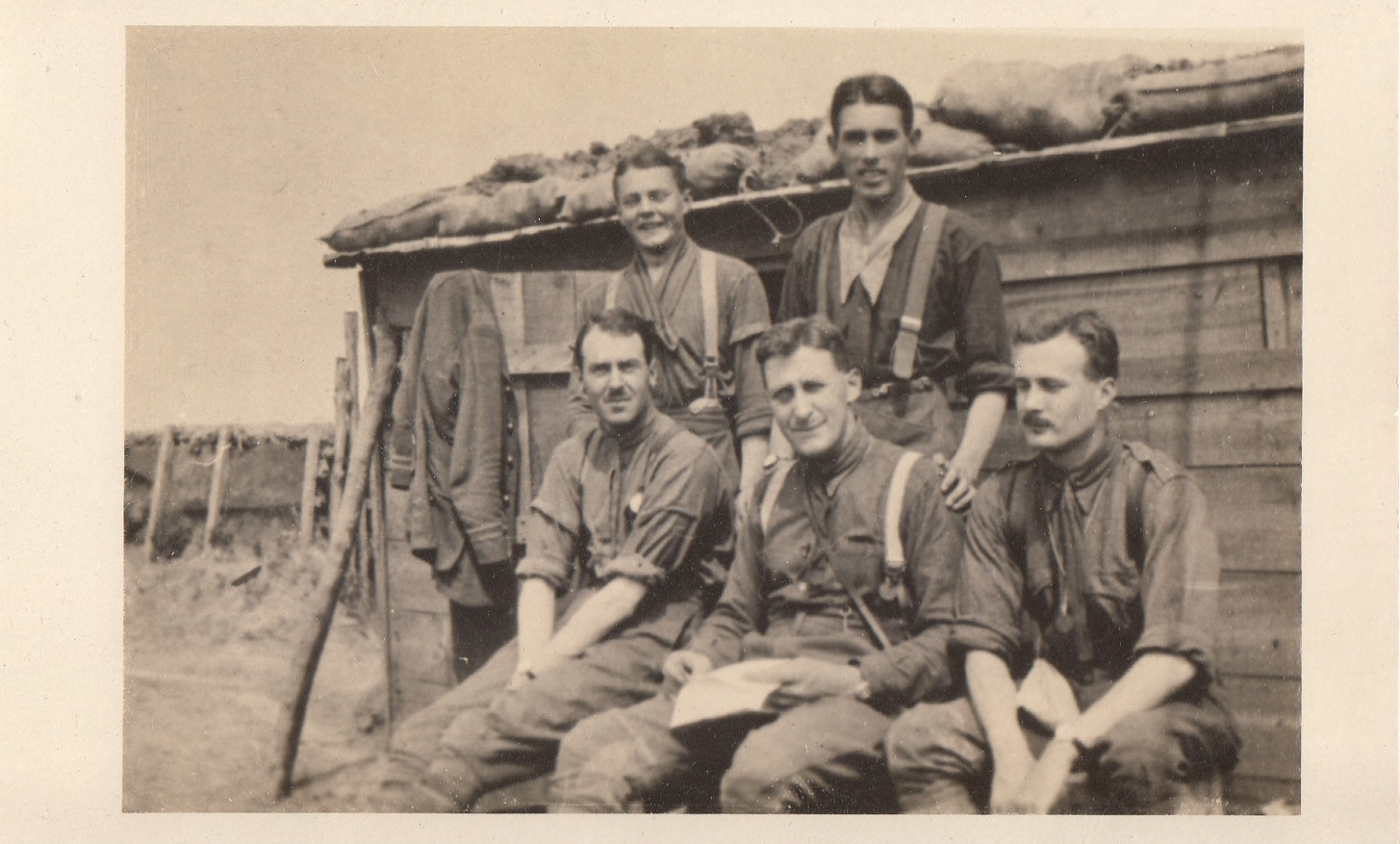
Officers from A Company.
Barwell, Dickinson
Savill Jones and Green.
The photograph is taken outside one of the huts built at Houplines into the mud and timber barricades built over the low lying valley between Houplines and the German lines.
2nd Lieutenant Ray Dickinson, the son of Lady Dickinson, mentioned in the letter above was well known to both John and Frances Baber, as he had been brought up at 6 Phillimore Gardens, very near to 9 Phillimore Gardens where John's parents lived in Kensington. Ray had volunteered for the battalion in the very first days of the war. He was close to my grandmother and may have been her boyfriend. She remained in contact with Ray's sisters long after Ray had been killed on the October 2nd 1915, by when he had become Captain in command of the Company. Ray was one of John's great friends in the battalion, and they planned to take their leaves together. He features in many of John's letters.
Lieutenant RS Savill would remain with the regiment for many years, becoming the Commanding Officer and returning the final Cadre to Regimental Headquarters on June 2nd 1919. He commanded the regiment until 1922, and died in May 1967. He was the only one of the officers in the photo to have survived the war.
2nd Lieutenant J. A. Green must have joined the QWR after October 31st 1914 but before they went up to the front on November 16th 1914, when he is listed with the others in Henriques account.
2nd Lieutenant F Barwell remained with the battalion into May 1916, after which he transferred into the Royal Flying Corps. He met his death on April 26th 1917 over Beaumont Hamel in a dog fight where he was overwhelmed by about six enemy aircraft.
[1] Honourable Artillery Company. The oldest artillery unit in the British Army dating back to the days of Henry VIII. My grandfather Reginald Hancock served in the HAC in 1911 and 1912 while he trained at the Royal Veterinary College, at one point becoming a Lance Bombardier (unpaid.) He was to serve as a Veterinary Officer throughout World War I.
[2] John's mother added a note to the effect that Willcock had been awarded Chevalier of the Croix d'honneur. I have no further details about Harold Willcock and would be pleased to learn more if you are aware of any further information about him.
[3] Patterson Barton, John’s uncle a regular in the Indian Army, who shortly arrived in France with his battery on the 6th of November, but of course John was not at this point aware of it.
John had not been accepted for the Regulars when he had applied in about 1912, and this had upset him, so it was one up for him that he had beaten his uncle into action.
[4] Ray Dickinson.