Showing posts with label First World War. Show all posts

Sunday, 28 December 2014

Hazebrouck to Bailleul 10th & 11th November 1914


Bailleul 12th November 1914. Showing ASC Transport in the Square.
The original Town Hall is on the right. This was destroyed later in the War.
 
 
The battalion left it's billets in St. Omer at 9 a.m. on November 10th for the 15 mile march to Hazebrouck.
  
In his small pocket diary John Baber recorded his impressions of the march.
 
"Tuesday, away fairly early.  Very damp & cold.  Oh. that pave. Billets Hazebrouck. D'md good bed. No guns."
 
John also wrote an short account of these events much later in his old age.
 
"From the camp we marched by easy stages towards Hazebrouk.  At one point, approaching a fork in the road I was sent forward to make sure we took the right road, and there approaching, were the remnant of a squadron of French cavalry.  With steel breastplates, brass helmets with plumes, some shorn off, with men bandaged and obviously fresh from a fight with Uhlans, they were a fit subject for a painting by Lady Butler of past battles."
 
John Baber also recorded his impressions of the following days march to Bailleul, which proved more difficult than expected, and which did not reach its original destination, due to the congestion encountered on the roads.

 "Wed.  Paraded in square 9.30. More pavee. Scarlet Fever in E Coy. Stopped at Bailleul for night instead of Steenwerck. Factory barracks & Munsters raised hell.  Fed well at Hotel Des Canons d'Or.  Heavy firing all night."

The Hotel Des Conons d'Or was a new one established in 1910 in Bailleul, and which had been an early cinema showing films before the war. Prices ranged from 1 to 0.25 francs francs. [1]

Writing in a letter to his sister, Frances Baber John expands on the battalions encounter with the Munsters.

"All the regulars here love to pull our men's legs, & to pour out lurid stories of the war;"
  
Captain Henriques in the regimental history also wrote about the refugees they had met on the road to Bailleul, writing long after the end of the war.
 
"The second day's march brought the Battalion to Bailleul. The road was crowded with numbers of refugees, the old people riding in carts, the younger ones walking and pushing handcarts and perambulators piled high with a motley assortment of household goods hastily gathered together. Most of them seemed to accept their lot in a curiously matter of fact way, though here and there one saw signs of real distress."
 
Private Bob Brookes who was one of the Battalions signallers has also  left an excellent diary that is available on the internet, and is well worth reading in parallel with this blog. He paints a very different and more immediate view of the refugees crowding the roads.

"At 11.00 am we arrived at Hazebrouck, having travelled some 15 miles, and we entered the town and saw a sight which brought tears to my eyes, and I will never forget it. 
 
From the direction of the Firing Line came streams of men, women and children, carrying all they could with them, having had to leave their homes.  Very stained and weather-beaten, for they had been walking for a long time, having had to rush away from their houses, risking their lives from shell and rifle fire. They carried large bundles filled with articles (some had a blanket-full on their back) and they were crying enough to break their hearts.  We got into communication with them, and they informed us that the Germs, who had taken all food and everything of value from them, were again advancing.  Many of them had been in Germs’ hands for some time, and they told us many woeful tales.  It is as sad a sight as one could possibly see."  [2]
 
Brookes also mentions the arrival of Scarlet Fever in Captain Shattock's E Company and how hard the marching was proving for troops who had little previous experience of marching, and who had been issued with new boots shortly before the left England. Brookes as a signaller was on one of the battalions bicycles.

"11.11.1914 At 9.30 am next morning, Wednesday 11th November, we departed from Hazebrouck, leaving one section of ‘E’ company behind on account of an outbreak of fever.  We passed through the village of Borre, and arrived at Bailleul at midday.  We were to have gone on further, but there was a strong wind and a drizzle, and the cobbled roads were proving too much for the feet, (I cycled) that the Colonel decided to put up here.  The march had been very difficult inasmuch that the ranks had to be broken several times to allow A.S.C. Motor Transports to pass, the road being very narrow.  This helped to make the marching harder."


The same view in Bailleul 2008, with the rebuilt Town Hall to the right.
 
I would very much like to locate both the Convent mention and the Hotel Des Canons d'Or.  If you can tell me where they were located, I would be pleased to hear from you.  I can be contacted at balmer.nicholas@gmail.com


Sunday, 14 December 2014

Christmas 1914 H C Lovell Cartoon


Christmas 1914 contrasted with those of former years by H C Lovell,
 and subsequently kept by John Baber


Rear of Christmas Card
 

 One of the fascinating aspects arising from writing a blog like this one, is how often a post will spark off correspondence with other people who have a common interest in the QWR.
 
Steve Hammond is one of the most committed researchers into the QWR and without his help the following post would only be a shadow of what it has become.
 
 
Whitmore & Sergeant Nutting.
[Captain J.B. Whitmore original commander of D Company.  Sergeant Nutting wears a Sheepskin waistcoat like that shown in Lovell's cartoon. The photo was taken at Houplines, and Buck House can be seen in the background. The barricade that formed the front is over Nutting's shoulder, and the German's are only 300 to 400 yards to his right]
 
 
In John Baber's papers I had found the Christmas Card shown above, that John had kept. I had drafted a post to go out on this blog before Christmas this year, and had spent some time wondering who H C Lovell was, however, I had been unable to locate his details. He doesn't appear in Henriques book, or in John's diaries.
 
Steve mean while had spotted the following medal group for sale between the 10th and 11th of  December 2014 by Dix Noonan, Webb Auctioneers. [1]


Captain H. C. Lovell, King’s Royal Rifle Corps, late London Regiment
1914 Star, with copy clasp (1177 Sjt., 1/16 Lond. R.); British War and Victory Medals (Capt.); Defence and War Medals (43901 Capt. H. C. Lovell, K.R.R.C.) privately impressed; Territorial Force Efficiency Medal, G.V.R. (1177 C.Q.M. Sjt., 16/Lond. R.) Cadet Forces Medal, G.VI.R. (A/Capt.)
 
It transpires  that Henry (Harry) Chandler Lovell had been born in Hammersmith, London in 1883.

He had joined the Queen’s Westminster Rifles well before the war in about 1908. He had become a Sergeant by the time that the Regiment went to France on 1 November 1914 (clasp confirmed on m.i.c.).

Like a lot of pre-war NCO's and volunteers, he was subsequently selected to become an Officer.  On 25 January 1916 he received a commission in the 20th (Blackheath & Woolwich) Battalion London Regiment. He was promoted to Lieutenant in July 1917, and attained the rank of Acting Captain in September 1918.

He appears to have remained in the Territorial Army after the war. He was awarded the T.F.E.M. by A.O. 67 of February 1919.

Lovell relinquished his rank on ceasing to be employed in April 1919 however he was granted the rank of Captain in the Territorial Force Reserve of the 20th Battalion London Regiment in March 1920.

In later civilian life he appears to have moved away from London, as he was appointed Postmaster in the Royston Sub-Office, Oldham, Lancashire. His obituary states that after the war he served with a Church Lads Brigade Battalion, which was at the time associated with the K.R.R.C.

He was appointed a Lieutenant in the National Defence Corps in June 1939 and as Lieutenant and Quartermaster in June 1940, before being granted the rank of Captain upon his retirement in September 1942.

Soon after he was commissioned as a 2nd Lieutenant in the City of London Army Cadet Force and was advanced to Lieutenant in October 1943. Lovell retired having reached the age limit in April 1951 and was awarded the Cadet Forces Medal. He died at Hillingdon Hospital, Middlesex on 15th June 1953.

Lovell was obviously a skilled cartoonist. Steve Hammond has made me aware of another of Lovell's cartoons that has survived.  This one was done at the end of October 1914, for Olive Seabrook the daughter of Arthur Seabrook the Landlord of the Leather Bottle Pub at Leverstock Green.  The Regiment had been sent to Leverstock Green following mobilisation in August 1914, until they were sent out to France.
 
The full story of this visitors book can be read at the listed below [2]  which contains a number of other images of pages signed by other members of the regiment.


Lovell's Cartoon showing the Kaiser Fleeing before the battalions bayonets.
If you have found this blog due to your interest in HC Lovell or are aware of any other cartoon's by Lovell, Steve and I would be fascinated to hear from you. I can be contacted on balmer.nicholas@gmail.com 


Sunday, 16 November 2014

2nd Lieutenant Ray Dickinson.


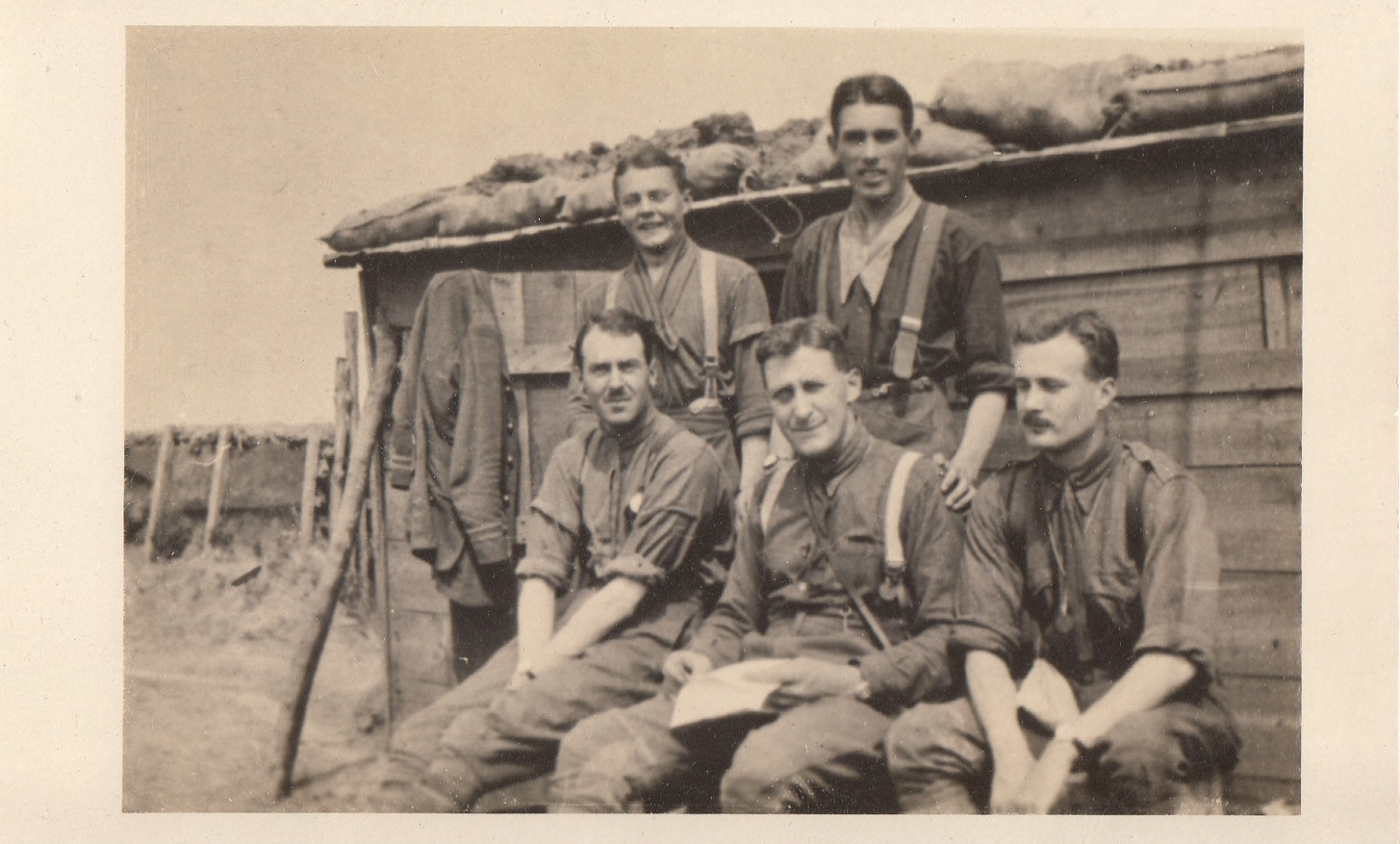
A Company Officers behind their hut in the Spring of 1915.
Barwell Dickinson
Savill Jones Green

2nd Lieutenant Ray Dickinson, the son of Lady Dickinson, was well known to both John and Frances Baber, as he had been brought up at 6 Phillimore Gardens, very close to 9 Phillimore Gardens in Kensington where John's parents lived.  Ray had volunteered for the battalion during  the very first days of the war. 

John wrote in his diary on the 4th of August 1914,

"Ray enlisted, mobilised. British return ultimatum to Germany commences at Midnight."

On the  Friday 14th of August . John wrote "Morning route march.  RSD joined."

Perhaps they had not been able to process his enlistment on the 4th.


Ray Dickinson, a photo taken at Cheltenham,
 and kept by my grandmother to her death.
 

He was close to my grandmother and may have been her boyfriend.  She remained in contact with Ray's sisters long after Ray had been killed on the October 2nd 1915, by when he had become Captain in command of A Company. Ray was one of John's great friends in the battalion, and they planned to take their leaves together. He features in many of John's letters, as will become apparent in future posts.

In the run up to Christmas 1914, he found time to send the following card to my grandmother. It was to be his last Christmas.


Initially in B Company, under Captain Cox, when on embarkation, the battalion was changed to a four company structure he moved into No.1 Company, was then renamed A Company.

On the 16th of November 1914 this company was the first of the QWR to move up into support of 16th Infantry Brigade, and for the first time they came under fire as they carried trenching materials into the line.

He was killed on the 2nd of October 1915 near Verlorenhoek Road by shell fire as they were repairing trenches collapsed by the recent rainfall, near the aptly names Stink Houses.

He was remembered by Henriques for "His happy and cheery character, his fearlessness and his power of leadership, had made him implicitly trusted as well as beloved by his seniors and adored by his company."

Dickinson Raymond Scott, Captain London Regiment (Queen's Westminster Rifles) 02/10/1915, Age 22, W.6. Potijze Burial Ground Cemetery (Ieper) (West Vlaanderen Belgium. [1]

[1] I am indebted to Steve Hammond for this information.


Friday, 14 November 2014

Marching to the sound of the guns.

The Queen's Westminster Rifles had been told as recently as October that they would not be expected to go to France until the Spring of 1915.

The regular Army had been suffering appalling casualties ever since the initial action at Mons, but remained unwilling to accept that they must call on the Territorial Army units training in Great Britain.  By the middle of October 1914 the situation had become so bad, that at very short notice the first units were called out to France.  The sector around Armentieres was seen as a "quiet sector"  suitable for these untried units.

Lord French had however to accept that he must use Territorial units if he was to prevent the line from breaking. He decided that although the Queen's Westminsters and the 8th Royal Scots had only arrived on the 1st and 8th of November respectively, yet their condition was so good that they were able to be sent to the front immediately after the H.A.C.[1]


John Baber, in his final days at Cambridge in the dark suit and cap,
his mother Clara is in the centre in a dark outfit and hat,
Frances, John's elder sister, also in a dark outfit stands to the left. The photograph
was taken at during the May Week on Wednesday 10th June 1914 at the grandstand
for the Bumps Race. Later that month events in Sarajevo would wreck their World
along with all those others there.

John wrote very differently to his sister than he did to his parents. This is demonstrated by the following letter, written describing his thoughts as the order came in to go to the front for the very first time.  As he would continue to do throughout much of the war he wrote in a light hearted way for his sister.
The letter can only be dated from the postmark on the envelope.  The letter is written in indelible pencil as required by orders.  The letter has been signed by Colonel Shoolbred on the reverse to show that it has been censored.


Mother’s and Dad’s letters of the
4th have just arrived.  I was glad to get them.
The parcel has not turned up
As yet, but I expect it will
Do so shortly.
Please congratulate Harold Willcock’s [2] folk for me.
It is rather odd that I know
4 men who figure in that list.
News just come that
We are moving up to the trenches at 8AM tomorrow.
Poor old Pat [3] has been done
In the eye after all!  By the time this reaches you I shall
Probably have been
Fighting almost a week.
Isn’t it a splendid compliment
To the Regiment.
I suppose I ought not to say that.


Page 2,

We have all been
Ordered by all sorts of officers of
Senior rank to keep our heads,
Down, so will take no risks.
Am to hungry to write more.
Love to all

John.

Ray [4] is fit as a fiddle
& in fine form.

Later  Parcel just come
Thanks most awfully
Only just in time.


Officers from A Company.

Barwell, Dickinson
Savill Jones and Green.
 
 
The photograph is taken outside one of the huts built at Houplines into the mud and timber barricades built over the low lying valley between Houplines and the German lines.

2nd Lieutenant Ray Dickinson, the son of Lady Dickinson, mentioned in the letter above was well known to both John and Frances Baber, as he had been brought up at 6 Phillimore Gardens, very near to 9 Phillimore Gardens where John's parents lived in Kensington.  Ray had volunteered for the battalion in the very first days of the war.  He was close to my grandmother and may have been her boyfriend.  She remained in contact with Ray's sisters long after Ray had been killed on the October 2nd 1915, by when he had become Captain in command of the Company. Ray was one of John's great friends in the battalion, and they planned to take their leaves together. He features in many of John's letters.

Lieutenant RS Savill would remain with the regiment for many years, becoming the Commanding Officer and returning the final Cadre to Regimental Headquarters on June 2nd 1919.  He commanded the regiment until 1922, and died in May 1967.  He was the only one of the officers in the photo to have survived the war.

2nd Lieutenant J. A. Green must have joined the QWR after October 31st 1914 but before they went up to the front on November 16th 1914, when he is listed with the others in Henriques account.

2nd Lieutenant F Barwell remained with the battalion into May 1916, after which he transferred into the Royal Flying Corps.  He met his death on April 26th 1917 over Beaumont Hamel in a dog fight where he was overwhelmed by about six enemy aircraft.

[1] Honourable Artillery Company. The oldest artillery unit in the British Army dating back to the days of Henry VIII. My grandfather Reginald Hancock served in the HAC in 1911 and 1912 while he trained at the Royal Veterinary College, at one point becoming a Lance Bombardier (unpaid.) He was to serve as a Veterinary Officer throughout World War I.
[2] John's mother added a note to the effect that Willcock had been awarded Chevalier of the Croix d'honneur. I have no further details about Harold Willcock and would be pleased to learn more if you are aware of any further information about him.
[3] Patterson Barton, John’s uncle a regular in the Indian Army, who shortly arrived in France with his battery on the 6th of November, but of course John was not at this point aware of it.
John had not been accepted for the Regulars when he had applied in about 1912, and this had upset him, so it was one up for him that he had beaten his uncle into action.
[4] Ray Dickinson.

Wednesday, 22 August 2012

Advance to Contact

Figure 1. Page out of pocket diary John Baber
kept with him and into which he made daily entries 

 Here is a transcription, of what even John admitted was his appalling handwriting.

"Tuesday Nov 3rd.
9 O'clock disembarked.
11 O'clock marched up to
rest camp up on Hill.
Black horse jibbed.
People seemed pleased
to see us.
Black horses gave us
the Dickens of a time.
Meals
AM 7 O'clock Tea - 1 biscuit.
PM 4 O'clock, Bread butter jam
& tea"

The black horses referred to were the horses that John's machine gun section used to pull the limbers that carried the battalions machine guns.

Writing in the 1960's John recalled, perhaps forgetting that first days climb up the hill from the harbour. The horses must have had a distressing time loaded in and out of a ship, very probably for the first time in their lives.

"But the horses were a dream.  Our Commanding Officer was at the head of a big London store.  He knew a lot about a few things and particularly horses, stalking and old brandy.  Those were the days when you still saw as many horses as motors in London and this store were rightly very proud of theirs, and in August 1914 we mobilised their horses with their drivers.  In the two limbers we had teams of matched light draught and in the wagon an equally splendid pair of heavy draught.  When we got to France we had to mount an armed guard over the horse lines every nigt to prevent them being pinched by the Australians or someone equally knowing."

Having spent their first night in France in a tented camp on top a a hill over looking L'Havre the battalion officers had the first of many concessions to the rapidly changing face of war. The smart leather Sam Browne belts they had been accustomed to wearing were handed in as well as their swords, to be replaced with webbing equipment similar to that worn by their men.

On the late afternoon the battalion marched back into L'Havre to the Gare Maritime.  In the town they learned from the morning papers that the London Scottish, the First Territorial Battalion to go into action had been involved in a fierce battle at Messines.

Arriving at the station, they saw their first Germans, a group of "mere boys, others bearded men, was being marched away under escort to a concentration camp."  [1]

Due to leave the station at 7pm, the train would eventually set off three and half hours later, getting to Rouen at Midnight.

"Wed Nov 4.
 Had a good culprits sleep under canvas & kit and valise, off again this afternoon.  Made some new limber arrangements.  Parade 3.15 pm intrained 9.30pm for St Omer.  Started 10.30 Horrible march over the cobbles.  Pack gave my shoulder gyp."

John had had his shoulder blade broken in a Rugby accident at Marlborough College, and this had led to his failing a pre-war medical when he had tried for a Regular Commission. He had hoped to follow his Grandfather Charles Barton, a Major General into the army.

He must have been very concerned by the pain he was feeling.  Would his shoulder hold up?

The Queen's Westminster's had travelled over with the Liverpool Scottish, and had had a concert on board the ship. John and his men must have enjoyed a song popular sung by the Liverpool Scottish, because he wrote it into his diary on the 4th November.

"Liverpool Scottish's Song

We don't care what becomes of us.
We don't care if we get wet through
We don't get what the German's say.
Anything or anywhere
Fore we're going to shoot the beggars in the morning
So tonight boy we don't care."

I wonder if his men were signing this as they passed through L'Havre on their way to the station?

Shortly after leaving on the train, they must have seen more German prisoners because John wrote.

"Saw some German prisoners.  One old man, one strong man, & the rest all boys, Poor little brutes!
Seats hurled from the window! Fortunately there was no line there."

They travelled on towards St. Omer along a very circuitous route, enlivened by the cheers and shouts of the French local population who had collected along the route to hand the troops bread, fruit and chocolate.

They eventually halted at Abbeville for a longer stop, and then again at Calais.  Here OXO was supposed to have been made available for the troops. The cooks de-trained and had just completed the heating up of the drinks, when unannounced the French train driver set off, leaving the cooking party on the platform, and the passengers without anything to drink.

"Thursday Nov 5.
Route.
Havre Rouen, Sergueux, Cabancourt, Aumale, Camaches, Oisemount, Longforet, Abbeville, Quanol, Vieton, Etaples, Le Tourquet, Dammes, Boulogne, Calais, St Omer,


Supplemented rations by bread & wine, Lovely day, country beautiful. Splendid picnic.  Abbeville an hours halt & so much food that we don't know what to do with it all, some guns returning damaged, also wounded."

I cannot locate several of the places listed, so that it is quite possible that John was writing them down as he heard the names called out.

At St. Omer the battalion left the train and moved into the some barracks in the centre of the town.  Here they met survivors from the 2nd Royal Irish Regiment, who had been withdrawn from the fierce battles in the dash to the Sea that was going on between Arras, Ypres and Nieuport.

"Nov 6th
On reaching St Omer I waited with D Coy to detrain Transport not getting to the Caserne Paris Barracks till after 4AM. Royal Irish Rifles in our Barracks. Am told the Germans have just ended a gigantic attack & that we have practically only Reserve men left."

No doubt curious to get a first hand understanding of how well these new reinforcements from the Territorial Army were prepared Sir John French, the Commander in Chief turned up quite unannounced and visited the men.

"He came into the barracks quite alone, and chatted to several of the men who were standing in the square.  None of them recognised him; in fact, after he had left, one of the men said that a "general of sorts" had been in the barracks and had been looking around."

French went on to visit the Officers Mess and spoke to the officers. On the following days the battalion was put through a series of exercises, and on the 7th of November dug a line of reserve trenches on high ground about six miles to the east of St. Omer. A practise attack was put in on the 9th, which must have been

"Sat Nov 7th.
Battn out digging (Lof D) Orders to move tomorrow cancelled in evening.  Arrival of LRB, 13th Vics & others.  Why aren't we moving?  The intelligent peasant? Drew tools from OC ammunition transport.  Acques.  Saw new shell cap?  Colassale!" [Sic.]

"Sunday Nov 8th
Apparently our orders been cancelled because Terr: Battns wanted more training before going up.  I did one or two attack practises today. Country to open for MG to be of much use.  Major Needham (Our Brig'dd Major) said that we were by far the best Terr Battan he had ever seen.
Dined at Hotel de France.  I watched his German prisoners!  Was the Mayor's friend a spy?"

John Baber had an elder sister Frances Baber, at home in London, to whom he wrote frequently.

Often these letters were quite different in tone, to those that he wrote to his mother or father. He referred to her as Frank.

"Monday Nov 9
Dearest Frank


Breakfast is over & I have a spare 1/2 hour before work.  It is good to be over here, I think that the freshness & change, which always accompanies a trip across the water, have probably saved us all from becoming stale.  I have several odd jobs to do, which entailed my taking the section to neighbouring villages, but my Parisian accent so far, has prevented me from losing my way!  It is very odd having to look after some 20 helpless Britishers instead of being dependant on my family for conversational support. Yesterday we were doing some field work when I noticed a rascally looking fellow listening very carefully to what I was saying so I told him to "allez vous en, vite, vite, vite."


I followed him & found him examining a rifle further along; so I had him shadowed by your friend Corporal Roche, & finally he was arrested & marched back to the town.  He proved to be the most intimate friend of "Le Maire," who nearly fainted with horror.  However it served the beggar right for being to darned inquistive.  A lot of the peasants round here are in German pay, the brutes.


We are at present doing the same work here, as at Leverstock Green, but to the tune of continual boom-boom-Boom-boom-boom- in the near distance.  We have no orders but I expect we shall soon be "sent up", (as it is called here). Yesterday the sky was full of our aeroplanes.  I was talking to a Flying Corps man yesterday.  He says he loves war!  One & a half hours work a day & the rest of the time spent however he likes, is what he told me.  He was to say the least of it modest.  All regulars here love to pull our mens legs, & to pour out lurid stories of war; it is very funny, our new Brigade Major said yesterday that we were by far the best Territorial Battalion he had ever seen, & he has seen the pick of them out here. 
Love
John."

In his short diary for the following day John records

"Monday Nov 9th
Companies find out tonight [...... illegible] to go up 'next day.
Brigadier came to look us up & wish us luck!  1st March.
Tuesday away fairly early, very damp & cold, OK.  that pavee. billets for night at Hazebrouck D'd good bed.  No guns."

[1] Henriques.

Sunday, 5 December 2010

The Journey to France November 1st 1914

Figure 1. Machine Gun Section, Queen's Westminster Rifles, October 1914.
This photograph appears to be one of a number taken at various locations in
Leverstock Green immediately before embarkation.
This photo was probably taken at Wells Farm outside the barn
where the men were billetted.

The Queen's Westminster Rifles had not expected to be sent to France until the Spring of 1915. Indeed as recently as the 17th of October John Baber and his fellow officers had been regretting that they would miss out on the events in France.

However during October 1914 the British Expeditionary Force fought the Battle of La Bassée, [1] which had started on the 10th of October and would continue until the 2nd of November 1914  suffering yet more serious casualties to those already sustained by the rapidly diminishing regular army since the outbreak of the war. 

Having blocked the German armies assault on Paris on the Marne, the French and British armies were having to deploy towards the Channel Coast to cover a rapidly widening front, as the German's had moved their forces towards the north in an attempt to outflank the French & British Army.

Fighting rapidly spread to the north with the 1st Battle of Ypres starting on the 19th of October. Armentières had fallen initially into German hands, however counter attacks forced them back through Houplines.


Figure 2. Map Showing the approximate position of the front line in October 1914
during the Battles of La Bassée and 1st Ypres. [2]

Faced with very heavy casualties, and rapidly diminishing reserves of regular troops, the British Expeditionary Force needed to find additional forces to fill the rapidly extending front line trenches.

British casualties in the fighting between 14 October and 30 November were 58,155 (7,960 dead, 29,562 wounded and 17,873 missing). The army had arrived in France with 84,000 infantry. By the end of the First Battle of Ypres, the BEF had suffered 86,237 casualties, most of whom were infantry.  The French suffered around 50,000 casualties during the battle.[3]

The Queen's Westminster Rifles were to be amongst the very first Territorials to enter the line.

John Baber's pocket diary records the start of the journey to France.

"Sunday Nov 1st


Left Well Farm
Entrained Watford
in 2 parts.
Long stop Addison Rd
Embarked 5.30 pm
Sailed 9.30
Smooth Crossing
Warm night
Liverpool Scottish on own
Boat. Very good cot
No escort, lights out. Where
is the submarine which
Sank that old union."

At Southampton Docks the battalion found itself in company with the Liverpool Scottish, who travelled on the Maidan, an 8,000 ton steamship of the Anchor-Brocklebank Line. The Maidan was one of nine vessels in convoy who left Southampton at 6.30pm on the night of the 1st of November. The men felt very exposed as they passed the Isle of Wight as the ships were lit up by searchlights from the shore intended to stop German naval raids on the Solent anchorage.


Figure 3.  Men of the Queens Westminster Rifles arriving at Le Havre
on S S Maidan on the morning of 2nd November 1914.

John Baber recorded the arrival at Havre.

"Mon Nov 2nd
arrived off Havre
8 o clock
entered harbour
no we didn't
we missed the
tide. Splendid
mistake!
Entered harbour 11 PM.
More transports
arrived.
Belgian refugees
left."

In a letter written to his mother he wrote..

Nov 3 Tuesday
Dear Mother,
    Marching to Watford we entrained to Southampton: from here I must omit names, as expected.  However, we sailed in the Maidan, on Sunday evening & arrived at our destination in France early next morning.
We are now under canvas on a high hill overlooking the sea, for all the World like Dover.  It is called a rest camp & we hope to revisit it again.  Rays [4] cousins were on board our transport.  Riding from the harbour to our camp, I could not help over hearing many embarrassing critisms.  However they were all very good natured.
1st Female. C'est un jolie officier.
2nd Female.  Oui, mais un bébé.
It is really quite hot here & beautifully sunny.
Tell Dad to examine my pass-book fairly regularly, as in the possible event of us being engaged & of myself being captured, I might convey the information by giving a cheque to the German Red Cross.
Please send my spare of boots at once & add Plasmon & one Times a week to my weekly list.
I have changed my pony & am now riding quite a nice little nag, by the name of Belinda.  Although the Censor of course is under the seal of the confessional, it is rather embarrassing to know that ones letters will all be read & therefore mine will probably leave much to be desired, both in quality & in quality.  I have received Dad's letter & the receipted bill.  I can still manage the latter business.  We had a calm crossing with all the lights out & no escort.  I don't think anybody felt quite confident that there was not a submarine awaiting us.

Your loving son
John Baber.

Bob Brookes, a Private in the QWR also wrote an excellent account of the crossing, he however had experienced a considerably less comfortable journey. An extract from a much longer account is set out below.

"1.11.1914

On board the S.S. ‘MAIDAN’ the Liverpool Scottish were also proceeding to France, and we rapidly intermixed, related various incidents to one another, and discussed War, at the same time wondering to where we were going.

I stayed on deck as we went out of the Solent, and had an opportunity to exercise my knowledge of Morse Code by reading the messages to our vessel as to her name and other particulars.  Under the protection of a couple of destroyers we left the Isle of White behind after coming under the glare of the search lights several times.  It was a beautiful night, and the sea calm, looking very fine with the reflection of the search lights on the water.  After a time it became chilly and I went below to be served with some ‘Bully Beef’ (for the first time) and biscuits.  Tea was also provided, but like many others, I could not touch it.  It was not tea as we know it, but oil and tea leaves - by no means a pleasant combination.  The ‘Dixie’ ( a big pot - not of a kind one sees in the City) was filled with cold water and a pipe from the engine room blew steam into the water in the pot, and in this way the water was boiled.  Unfortunately the oil from the engines had made it’s acquaintance with the steam and every time tea was issued only a few men had any.  Fortunately I had filled my water bottle at Southampton, but this did not last very long as one gets very thirsty through eating ‘Bully’ and others, who had not filled their bottles had a ‘nip’ of mine." [5]

The battalion had had sing-song on the deck to pass the time before they could disembark.

John Baber remembered the first days in France in an account he wrote during the 1960's.

"We landed at Havre, and after we had off loaded gear and horses I found myself leading my little section to the Camp.  Sitting on my pony, all tied up with swords, holsters, revolvers, hay net, picketing peg and whatnot, I cocked a rather conceited eye at the interested passers by. Seeing remarkably good looking young women approaching, I prepared to receive a smile, but all that happened was that one said to the other "Ah, quel bebe!"

[1] See http://www.historyofwar.org/articles/battles_la_bassee.html for a good introduction to this battle.
[2] From"A Soldier's Sketches Under Fire" by Harold Harvey. Available from http://www.gutenberg.org/files/16056/16056-h/16056-h.htm Harvey served in Houplines during October 1914, stablising the front line the Queen's Westminster Rifles would enter a month later.
[3] From http://www.historyofwar.org/articles/battles_ypres1.html
[4] Ray, R.S. Dickinson.
[5] From http://www.bobbrookes.co.uk/DiaryCH2.htm This diary gives a very vivid picture of what life was like for the other ranks in the QWR, and is fascinating to compare with John Baber's account of life as an officer.


Tuesday, 5 October 2010

The Colonel.

Lt. Col. Shoolbred behind the barricade at Houplines Spring 1915.

Lt. Col. Shoolbred was not a professional soldier.  Before the war he had run and was the owner of James Shoolbred & Co. Limited, a furniture manufacturer and repository located at Tottenham House, Tottenham Court Road. 

The store had been established in the 1820's at 155 Tottenham Court Road selling textiles for home furnishing.  During the 1870's Shoolbred began manufacturing high quality furniture, and became Royal Warrant holders from the middle of 1880's.

One of the stores most popular items was it's jigsaw puzzles.

Sadly during the Depression and financial crisis of 1929 the store ran into difficultly and eventually closed its doors in 1931.

Lt. Col. Shoolbred had first joined the regiment in 1888 and was to rise up through the ranks until he took command from Lieut. Colonel C.A. Gordon Clarke in February 1911.

It appears that joining the Queen's Westminster Rifles may have been a family tradition. In the Bulletins and other state intelligence for the year 1863,

Commissions signed by the Lord Lieutenant of the County of Middlesex.
Queen's ( Westminster) Rifle Volunteer Corps.

Ensign Frederick Thomas Shoolbred to be Lieutenant.  Dated 25th April, 1863.
Walter Shoolbred to be Ensign, vice F. T. Shoolbred, promoted. Dated 25th April, 1863.[1]

The Colonel's company ran a large number of furniture delivery horse drawn drays, and these vehicles together with the drivers and horses joined the regiment at mobilisation,and many remained in the regiment throughout the war.

John Baber (who himself became Lt. Colonel in regiment between the wars) wrote of Shoolbred.

"Our Commanding Officer was at the head of a big London store.  He knew a lot about a few things and particularly horses, stalking and old brandy.  Those were the days when you still saw as many horses as motors in London and this store were rightly very proud of theirs, and in August 1914 we mobilised their horses with their peace time drivers."[2]

John Baber experienced the Colonel's generosity with old brandy when on the 11th August 1914 he made the following entry in his diary.

"11 Tues. Colonel’s speech.  Battalion Volunteers complete Told that whole of 4th 5th & 6th Brigades has done so, Officer of Lond Scots told me of 5% had been obtained with difficulty. 10 c Marriage of Geoffrey Cox and Miss Pitcher in Bath Chapel of the Abbey. Sword Posse by officers & B Coy.

10 o’c route march Trafalgar Square Regents Park Marylebone Road.  Tuesday evening CO gave Veuve Cliquot (04) Slept in full kit & boots ready to start at once. 150 rounds issued for each man.

Dinner in Sergeants mess. Phil & mother. (illegible) has gone."[3]

The Colonel  led the regiment throughout the first two years of the war, until eventually in October 1916 following the Battles on the Somme he was invalided home for two months sick leave on the 18th October 1916.After regaining his health he returned to the front, and went on to lead the regiment through the battles in 1917, until August 3rd, when he handed over command to Major P.M. Glasier.

His departure was a sad one, and the battalion and it's band turned out on August 4th 1917 to see him off.

[1] Bulletins and other state intelligence for the year 1863, by T.L. Behan, page 916.
[2] John Baber, Text of article written in the late 1960's.
[3] John Baber Pocket Diary for 1914.

Sunday, 26 September 2010

Mobilisation and the march to Leverstock Green

Figure 1. Crowds cheering long queues of recruits outside
the Headquarters of the Queen's Westminster Rifles. 

As soon as war was declared large numbers of volunteers and former members of the battalion reported to the regiment. The regiment had numbered 511, and within less than forty eight hours it had reached its full compliment of over 800 men. Many volunteers had had to be turned away. Something of the rush and confusion of these days can be seen in John Baber's pocket diary below.

Figure 2. John Baber's Letts Diary 1914.
(Please click on image for larger version.)

"4 Tues Ray enlisted.  Mobilized.
British ultimatum to germany expires at midnight.

5 Wed Battalion mobilisation Endowed Schools at 8AM.  Recruits poured in.
Drew nearly 220,000 rounds of ball SMA
Liege.  Went to Tower for Major, slept at home.
'London' sinks german minelayer

6 Thur More recruits....... Div Transport
Officers say 6th Brg on Monday, 5th on Tuesday
4th on Wednesday,
Ampion sunk by mine (135 lost)

7 Fri Battalion reached full strength, &
men turned away freely.
10.30 Route march.  3.30 pm Bayonet fighting
germans leave Liege. ? north sea Battle
Cerub in form
8 Sat Route march morning & afternoon

9 Sun 9aft Trin Church Parade.  Archdeacon
Wilberforce 'fire & sentiments not broadminded
disappointing address.  Home for afternoon.
French have invaded Alsace."

The regimental history mentions the route marches and says "but chiefly to be remembered by the route marches along tarred roads which reflected from the ground all the heat of a broiling August sun."

It also gives the Archdeacon a more favourable review than John Baber, saying of the service

"August 9th.  The Battalion attended a special service in Westminster Abbey.  The very impressive and stirring sermon preached by Archdeacon Wilberforce brought home to all, more than anything else had done up to that time, what was before them." [1]

Figure 3. A printed form of service from the 9th of August left
at Leverstock Green with Olive Seabrook.[2]

As a special privilege to the Queen's Westminster Regiment, the Dean & Chapter of Westminster Abbey allowed Lieutenant E.G.H. Cox commander of B Company get married in King Henry VII's Chapel inside the Abbey. It was the first wedding celebrated there in more than three hundred years.

London officer worker, Bernard Brookes was amongst the hundreds of men who arrived at the Queen's Westminster Rifles depot hoping to enlist. Here's his account of his successful attempt to join up.

"7.8.1914

I immediately took steps to join a regiment and on Friday 7th August 1914, with Frank Croxford and George Steptoe (two colleagues from the Office) I went to the Headquarters of the 16th Battalion of the County of London Regiment, the Queens Westminster Rifles and after waiting outside 58, Buckingham Gate for two or three hours we struggled and pushed our way inside as soon as the door was opened - we were all so eager to join the Army.  Strange to say, that men I have met since who have returned from the Front are even more eager to get out of it now, but although one had to wait a long time to get into the Army at the beginning of the War, one has to wait a sight longer to get out once in the Army.

After much swearing outside the building, we were ‘sworn in’ and then waited in turn to see the doctor.  I passed the Doctor as ‘Fit’ and was posted to ‘E’ company.  We then paid our entrance fee (rather a good idea - pay to serve one’s country) and the receipt for this money permitted free travelling on Motor Omnibuses and other conveyances, although in civilian clothes.  Unfortunately this practice was not continued long enough to make up the entrance fee, but I honestly did my best."[3]

On the 15th of August the entire 2nd London Division was inspected before it was moved off out of London on the following day.


John Baber records this inspection as follows


"15 Sat Brigade inspection in Hyde Park by Gen: Morland some casualities.  Reserves oust RSD, bad luck."


Presumably these casualties were men who fainted in the heat.

"16 Sun - 10 aft Trin Brigade assembled
Hyde Park.  11 O'clock Brigade left
Hyde Park.  Bivouacked at Edgware.
march short but roads trying. "


[1] Major J.Q. Henriques. The War History of the First Battalion Queen's Westminster Rifles 1914-1918. Page 4 & 5.
[2] From the the Queen's Westminster Rifles in Leverstock Green website at http://www.lgchronicle.net/QWR.html  this excellent website has a great deal of information on the time the battalion spent training in the area. It is well worth visiting.
[3] Bernand Brookes Diary is available on line at http://www.bobbrookes.co.uk/diary.htm and gives an excellent view of what it was like to become a member of the QWR at this time.


The Fulton family and volunteer rifle tradition in the Queen's Westminster Rifles

Figure 1. Sergeant A. G. Fulton. Photo taken by Lt. J.B.Baber.at Edmead's Farm
near Houplines, probably taken in May 1915. [1]

Sergeant Arthur Fulton was one of the stalwarts of the Queen's Westminster Rifles. An extremely able marksman, Fulton had been the King's Cup winner at Bisley in 1912, and would go on not only to survive the war, but also to win the Kings Cup for a second time in 1924.

Marksmanship was a family tradition.  Fulton's father, Sergeant G. E. Fulton had won the Queen's Cup in 1888 when serving with the Wimbledon Volunteers.


Figure 2. Sergeant Fulton from Middlesex.

George Fulton had started his shooting career in the Wimbledon Rifle Volunteers by 1881 and had won the Queen's  Prize in 1888, and the Grand Aggregate in 1890 and the St. George's in 1896 and 1900.  He went on to found his  own gun smithing company in about 1895.  At first this business operated out of Wandsworth before moving to Staines where there was a large range at the time. 

The National Rifle Association had moved its headquarters to Bisley Camp in 1890, and Staines was conveniently placed in relation to the ranges there and at Bisley. Fulton set up his business in a sectional wooden building equipped with verandas that was moved to the Bisley ranges from Wimbledon and which survives today [2]


Figure 3. Rifle Volunteers at Wimbledon 
(Please click on picture for larger image.)

George Fulton must have been one of the many young men who joined the Volunteer Rifles in the 1870's. The rise of Napoleon III's France and steam ships had made many in Britain concerned least an invasion be mounted on our shores. Any potential enemy could now arrive regardless of the wind.
The 1870 Franco Prussian War had shown just how vulnerable we had become with the advent of large European conscript armies just a few hours steaming from our coast.


Figure 4. South London Rifle Club at Nunhead Ranges 1879.
(Please click on image for larger version.) 
Private Low and Major Starkey of the QWR
are amongst the competitors.

This Volunteer movement has particularly popular in the Wimbledon, Peckham and Rye area and was open both to gentlemen volunteers and well as tradesmen like Fulton.  As can be seen from the photo above both gentlemen and ordinary men were able to mix at these events, which was not the case at most other times.  For many young men it represented the best way to get a holiday. The camps became great social events.

George Fulton's great ability in shooting must have attracted the attention of the Queen's Westminster Rifles, who were one of the keenest of these Volunteer Regiments, and they appear to have managed to lure George Fulton away by 1889 to join the unit. He was then enabled to set up his own business working to modify and improve rifles for competition.

"Staines, Dec.29.
15 November 1889
THE VOLUNTEERS."

"It was yesterday officially announced that Sergeant G.E. Fulton, of the Queen's Westminster Volunteers, the winner of the Queen's prize of £250 and the gold medal and gold badge of the National Rifle Association at Wimbledon last year, has carried off the championship and gold jewel of the North London Rifle Club this season with the best score ever recorded in the annals of rifle shooting under the same conditions. His aggregate of eight "shoots" at 200, 500, and 600 yards and of four at 800 and 900 yards with the Government Martini-Henry rifle totals exactly 1,100 points. Captain Cowan, of the Royal Engineers, is second with 1,088, and Corporal Leghorn, of the London Scottish, third with 1,073."[3]

George Fulton was a widely respected authority on rifles. In 1905 he wrote the following letter to the Times newspaper criticising the new service rifle then coming into service. 

"The Times
 
5 January 1905
TO THE EDITOR OF THE TIMES.
THE NEW SHORT RIFLE.


Sir, In your issues of the 19th and 22nd there appeared some correspondence respecting the new short rifle. I am very sorry not to have been aware of this at the time, but hope that you will allow me, though late, a little space for a few remarks.
I have tried several of these rifles up to 600 yards, and one at 800, and cannot understand how the Hythe School find that it shoots closer than the long rifle. My experience is rather the reverse.
For so short a weapon it is ill-balanced and top heavy, and so is ill adapted for swift alignment of sights necessary in quick but accurate shooting at short range, which, I believe, the rifle, strangely enough, is supposed to be designed for.
They have bored holes in the butt, under heel plate, to reduce weight a trifle. This only makes balance worse, and a badly-balanced rifle or gun always handles heavily. The small shallow open notch of backsight and the large projections of the open topped hood on either side of foresight also hinder quick off-hand shooting. A large deep notch is the best for quick sighting, especially in an indifferent light, and a foresight then stands conspicuously alone, as on the long rifle.
I make these remarks as quick shooting at short range has lately been so strongly recommended by the military authorities.
Your correspondents consider the sights of the new rifle superior. In finish they undoubtedly are; but a traversing wind-gauge sight is fanciful, not practical. All very well for making minute alterations of the sight scale, when the wind is being judged by the state of the flags on a range; but I have often asked those who have seen service of what use such sights would be, and the answer is what I expected.
A good, well-finished tangent sight, with a large sight notch in leaf-cap for short ranges, and a very small narrow one on sliding bar, just sufficient to take in a moderate amount of foresight, for more deliberate shooting and medium and long ranges, the tip of sight level, with shoulders of notch working the ground line of objects aimed at, on the old approved method, would be more to the purpose than the new sight, with only one notch, which neither suits one purpose nor the other. Another objection to the short rifle is the greater flash it makes in the dusk.
The safety catch is not so handy, or so readily moved, as another form that has long been adapted to this action by a large firm of rifle manufacturers.
In conclusion, the authorities would have acted wisely in issuing a few hundred of these short rifles for trial by the best known all-round shots in the Volunteer Forces.
I am, Sir, your obedient servant,
G.E. FULTON."
[4]

The rifle George Fulton was referring to became the Short Magazine Lee-Enfield Mk I, and was to become one of the most important rifles in military history, serving throughout the First World War and on into the Second World War.  Some remain in service in 2010 in India with the police force.

The Fulton's would go on to convert many of these rifles for target shooting. The main areas for improving were the screws that held the barrel to the wooden housing. With time and if maintenance was not regularly undertaken the screws would come loose and the wood would shrink, causing the barrel to move in relation to the wooden forward parts. This caused the rifle to loose accuracy. The Fulton's work on making it more accurate caused the Rifle Association to make the Bull's in targets smaller twice during the inter war period.

George Fulton was not unsurprisingly appointed the QWR's Armourer Sergeant. 

During 1905 he was part of a team lead by Captain Montagu De Mancha Shattock who beat an American team from the Seventh National Guard on July 6th and 7th at Bisley by 10 points.  Corporal Short, a National Guardsman hit the bulls eye with one of his shots, only to discover that it was on the adjacent target. This lost them the competition.

Between September 24th and October 7th 1906 a return match set up by Sir Howard Vincent, a wealthy former commander of the QWR was shot for at the Sir Howard Vincent Anglo-American Challenge Shield at Creedmoor near New York. An article in the New York Times contains the following paragraphs

"The make up of the English team this year is nearly the same as it was last.  Armourer Sergt. Fulton who has been in the regiment since 1881, is the crack shot.  His son A.G. Fulton, is nearly as good, having scored 261, against his father's 262 in the contest with the Seventh.  The father has the great distinction of having won the King's Cup twice.  His son missed it once only by a very narrow margin."

"From the accounts of the contest brought home by the Seventh's representatives, Armorer Sergt. Fulton is a most picturesque character. He is a gunsmith by trade, and is exceedingly quiet and unassuming.  At any sort of social gathering he never says a word unless it is tricked out of him.  Though he is a gunsmith and some of his fellows in the regiment come from the most aristocratic sires in Britain, the old Sergeant is much sought after." [5]

In the return match George Fulton does not appear to have taken place. Corporal Arthur Fulton, was one of the six in the team, and Rifleman Roche also shot in the match as one of two reserves. Sadly, on this occasion they were beaten by the American team. [6]

The importance to the Regiment of the Fulton's is hard to overstate. As soon as the Regiment mobilised in August 1914 they set to work to bring the rifles and marksmen skills to as high a level as possible.

The regiment had not been equipped with the Short Lee Enfield used by the Regular Army in 1914. These were in short supply, and reserved for Kitchener's new army.

The QWR were not expected to be sent overseas as early as they were.  As late as 29th September 1914 Lord Kitchener who inspected the unit at Gorhambury Park had told them "Not a man will leave until your second battalions are fully equipped and ready to take your place." [7]

Figure 5. Long Charger-Loading Magazine Lee-Enfield.[8]

On the 31st of October 1914, having been quite unexpectedly informed that the regiment was being sent to France, on the previous day, the 30th of October, it was then issued with an entirely new type of rifle, that they had not previously had any experience on. The rifle was one of the alternatives to the Short Lee-Enfield that had been rejected for regular service.

This was necessary because the one they had been training could not take the Mark VII cartridge being issued in France, which the Longer Charger rifle fortunately could.

Sergeant Arthur Fulton and his father George had suddenly to test and adjust approximately 800 new issued  rifles, working along with the other best regimental shots. 

The men themselves had no opportunity to test or familiarise themselves with the new rifles before they set off for France. Fortunately the main difference to the ones they had trained on, was in the sights and breach. These rifles remained in use until after the actions at Bellewaarde in 1915 when so many rifles were recovered from casualties in other units that it was possible to provide the battalion with the standard rifle used by the Regular units.


Figure 6. Private of the QWR equipped with the Long Charger
Lee Enfield during the winter of 1914-15 at Houplines. [photo by Lt J B Baber] 

Possibly because 2nd Lt Baber was one of the least experienced, and probably also the youngest officer, he was appointed as Machine-Gun Section commander, with Sergeant Arthur Fulton as his second in command. I expect that it was a great relief to Baber to have such an able man in day to day command of his unit.

The Lance Corporal was R. de R. Roche, another very experienced soldier who had served in South Africa during the Boer War as also in the machine gun section. He was George Fulton's brother in law, and a very fine rifle and pistol shot.

Sergeant Arthur Fulton displayed his skills as a marksman when he made a very remarkable shot. Spotting a German officer sitting in a window of a house in the village of Frelinghein well behind the lines, he estimated the range at 800 yards, and was able to pick the officer off with his first round. [9]

During November 1914 and into 1915 the Regiment suffered from having very little artillery support due to the shell shortage, and were suffering from German observation and snipers, so this success must have been a great morale booster.

Arthur Fulton went on to become well known in the 1918 to 1939 period for the unique distinction of being the only man to win the Sovereign's Prize three times, he has also won the King's Silver Medal three times and holds the record number of King's and Queen's Final Badges.

For many years' from 1920 until the advent of the P14 rifle in 1935, the S.M.L.E. was the only weapon permitted for the S.R. shooting under the N.R.A. Rules, and in the early days of that rifle's history the continuance of rifle shooting as a competitive sport undoubtedly hung in the balance. It was at this time that the pioneering work done by Arthur Fulton at Woolwich and in his spare time on privately-owned rifles which resulted in the process known as "packing" which did a great deal to bring about some sort of "levelling-up" of the standard of shooting obtained from these otherwise extremely inaccurate weapons.
By careful controlling the barrel vibrations, and skilfully adjusting the "packing" material so as to stiffen the otherwise weak barrel and action without restricting the expansion of the former, an extremely high degree of accuracy was obtained which enabled the size of the bullseye at all ranges to be reduced twice during this period.

Arthur Fulton who had a son, who became a noted shot in the 1950's, and a daughter was awarded the M.B.E. in the 1959 New Year Honours List for his services to rifle shooting.

A film from 1926 is held by British Pathe which shows the family of Sergeant Fulton called"Camera Interviews - Sgt. Fulton - The Famous Rifle Shot." which contains the following stills.


Figure 7. Sergeant George Fulton in 1926 (From British Pathe)

If you are connected to the Fulton family, or are able to provide any additional information on their activities with the QWR, I would be very interested to hear from you.


Figure 8. Sergeant Arthur Fulton with his dog Sailor in 1926
(From British Pathe)


[1] Edmead's Farm north east of Houplines village.  The farm formed part of the front line, but was totally destroyed by later battles in the area. It's location was at approximately 50 degrees 41' 52.09" N 2 degrees 55' 34.67"E. The site is just to the south west of the roundabout where the N58 from Belgium comes into France and joins the D945.
[2] G. E. Fulton & Son, registered gunsmiths.  See http://www.fultonsofbisley.com/history.htm
[3] from http://freepages.genealogy.rootsweb.ancestry.com/~fultondata/Biog01.htm
[4] from http://freepages.genealogy.rootsweb.ancestry.com/~fultondata/Biog01.htm.  See also http://www.milsurps.com/showthread.php?t=13678 for a very good article on the technical aspect of Fulton's work.

[5] The full article about this competition in New York can be found in the New York Times archive at http://query.nytimes.com/mem/archive-free/pdf?res=F20C11F6355A12738DDDAC0994DF405B868CF1D3
[6] Report from New York Times, 6th October 1906, available at http://query.nytimes.com/mem/archive-free/pdf?res=F20E13F73A5E12738DDDAA0894D8415B868CF1D3[6] Major J.Q, Henriques, "The War History of the First Battalion Queen's Westminster Rifles, 1914-1918." page 10.
[7] Photo copied from Arundel Militaria website, which has several other pictures of a surviving example. http://www.deactivated-guns.co.uk/deactivated-guns/allied-deactivated-guns/super-rare-wwi-charger-loading-lee-enfield-rifle/prod_679.html
[8] Henriques, "The War History" page 28.