Showing posts with label Houplines. Show all posts

Sunday, 14 December 2014

Christmas 1914 H C Lovell Cartoon


Christmas 1914 contrasted with those of former years by H C Lovell,
 and subsequently kept by John Baber


Rear of Christmas Card
 

 One of the fascinating aspects arising from writing a blog like this one, is how often a post will spark off correspondence with other people who have a common interest in the QWR.
 
Steve Hammond is one of the most committed researchers into the QWR and without his help the following post would only be a shadow of what it has become.
 
 
Whitmore & Sergeant Nutting.
[Captain J.B. Whitmore original commander of D Company.  Sergeant Nutting wears a Sheepskin waistcoat like that shown in Lovell's cartoon. The photo was taken at Houplines, and Buck House can be seen in the background. The barricade that formed the front is over Nutting's shoulder, and the German's are only 300 to 400 yards to his right]
 
 
In John Baber's papers I had found the Christmas Card shown above, that John had kept. I had drafted a post to go out on this blog before Christmas this year, and had spent some time wondering who H C Lovell was, however, I had been unable to locate his details. He doesn't appear in Henriques book, or in John's diaries.
 
Steve mean while had spotted the following medal group for sale between the 10th and 11th of  December 2014 by Dix Noonan, Webb Auctioneers. [1]


Captain H. C. Lovell, King’s Royal Rifle Corps, late London Regiment
1914 Star, with copy clasp (1177 Sjt., 1/16 Lond. R.); British War and Victory Medals (Capt.); Defence and War Medals (43901 Capt. H. C. Lovell, K.R.R.C.) privately impressed; Territorial Force Efficiency Medal, G.V.R. (1177 C.Q.M. Sjt., 16/Lond. R.) Cadet Forces Medal, G.VI.R. (A/Capt.)
 
It transpires  that Henry (Harry) Chandler Lovell had been born in Hammersmith, London in 1883.

He had joined the Queen’s Westminster Rifles well before the war in about 1908. He had become a Sergeant by the time that the Regiment went to France on 1 November 1914 (clasp confirmed on m.i.c.).

Like a lot of pre-war NCO's and volunteers, he was subsequently selected to become an Officer.  On 25 January 1916 he received a commission in the 20th (Blackheath & Woolwich) Battalion London Regiment. He was promoted to Lieutenant in July 1917, and attained the rank of Acting Captain in September 1918.

He appears to have remained in the Territorial Army after the war. He was awarded the T.F.E.M. by A.O. 67 of February 1919.

Lovell relinquished his rank on ceasing to be employed in April 1919 however he was granted the rank of Captain in the Territorial Force Reserve of the 20th Battalion London Regiment in March 1920.

In later civilian life he appears to have moved away from London, as he was appointed Postmaster in the Royston Sub-Office, Oldham, Lancashire. His obituary states that after the war he served with a Church Lads Brigade Battalion, which was at the time associated with the K.R.R.C.

He was appointed a Lieutenant in the National Defence Corps in June 1939 and as Lieutenant and Quartermaster in June 1940, before being granted the rank of Captain upon his retirement in September 1942.

Soon after he was commissioned as a 2nd Lieutenant in the City of London Army Cadet Force and was advanced to Lieutenant in October 1943. Lovell retired having reached the age limit in April 1951 and was awarded the Cadet Forces Medal. He died at Hillingdon Hospital, Middlesex on 15th June 1953.

Lovell was obviously a skilled cartoonist. Steve Hammond has made me aware of another of Lovell's cartoons that has survived.  This one was done at the end of October 1914, for Olive Seabrook the daughter of Arthur Seabrook the Landlord of the Leather Bottle Pub at Leverstock Green.  The Regiment had been sent to Leverstock Green following mobilisation in August 1914, until they were sent out to France.
 
The full story of this visitors book can be read at the listed below [2]  which contains a number of other images of pages signed by other members of the regiment.


Lovell's Cartoon showing the Kaiser Fleeing before the battalions bayonets.
If you have found this blog due to your interest in HC Lovell or are aware of any other cartoon's by Lovell, Steve and I would be fascinated to hear from you. I can be contacted on balmer.nicholas@gmail.com 


Friday, 14 November 2014

Marching to the sound of the guns.

The Queen's Westminster Rifles had been told as recently as October that they would not be expected to go to France until the Spring of 1915.

The regular Army had been suffering appalling casualties ever since the initial action at Mons, but remained unwilling to accept that they must call on the Territorial Army units training in Great Britain.  By the middle of October 1914 the situation had become so bad, that at very short notice the first units were called out to France.  The sector around Armentieres was seen as a "quiet sector"  suitable for these untried units.

Lord French had however to accept that he must use Territorial units if he was to prevent the line from breaking. He decided that although the Queen's Westminsters and the 8th Royal Scots had only arrived on the 1st and 8th of November respectively, yet their condition was so good that they were able to be sent to the front immediately after the H.A.C.[1]


John Baber, in his final days at Cambridge in the dark suit and cap,
his mother Clara is in the centre in a dark outfit and hat,
Frances, John's elder sister, also in a dark outfit stands to the left. The photograph
was taken at during the May Week on Wednesday 10th June 1914 at the grandstand
for the Bumps Race. Later that month events in Sarajevo would wreck their World
along with all those others there.

John wrote very differently to his sister than he did to his parents. This is demonstrated by the following letter, written describing his thoughts as the order came in to go to the front for the very first time.  As he would continue to do throughout much of the war he wrote in a light hearted way for his sister.
The letter can only be dated from the postmark on the envelope.  The letter is written in indelible pencil as required by orders.  The letter has been signed by Colonel Shoolbred on the reverse to show that it has been censored.


Mother’s and Dad’s letters of the
4th have just arrived.  I was glad to get them.
The parcel has not turned up
As yet, but I expect it will
Do so shortly.
Please congratulate Harold Willcock’s [2] folk for me.
It is rather odd that I know
4 men who figure in that list.
News just come that
We are moving up to the trenches at 8AM tomorrow.
Poor old Pat [3] has been done
In the eye after all!  By the time this reaches you I shall
Probably have been
Fighting almost a week.
Isn’t it a splendid compliment
To the Regiment.
I suppose I ought not to say that.


Page 2,

We have all been
Ordered by all sorts of officers of
Senior rank to keep our heads,
Down, so will take no risks.
Am to hungry to write more.
Love to all

John.

Ray [4] is fit as a fiddle
& in fine form.

Later  Parcel just come
Thanks most awfully
Only just in time.


Officers from A Company.

Barwell, Dickinson
Savill Jones and Green.
 
 
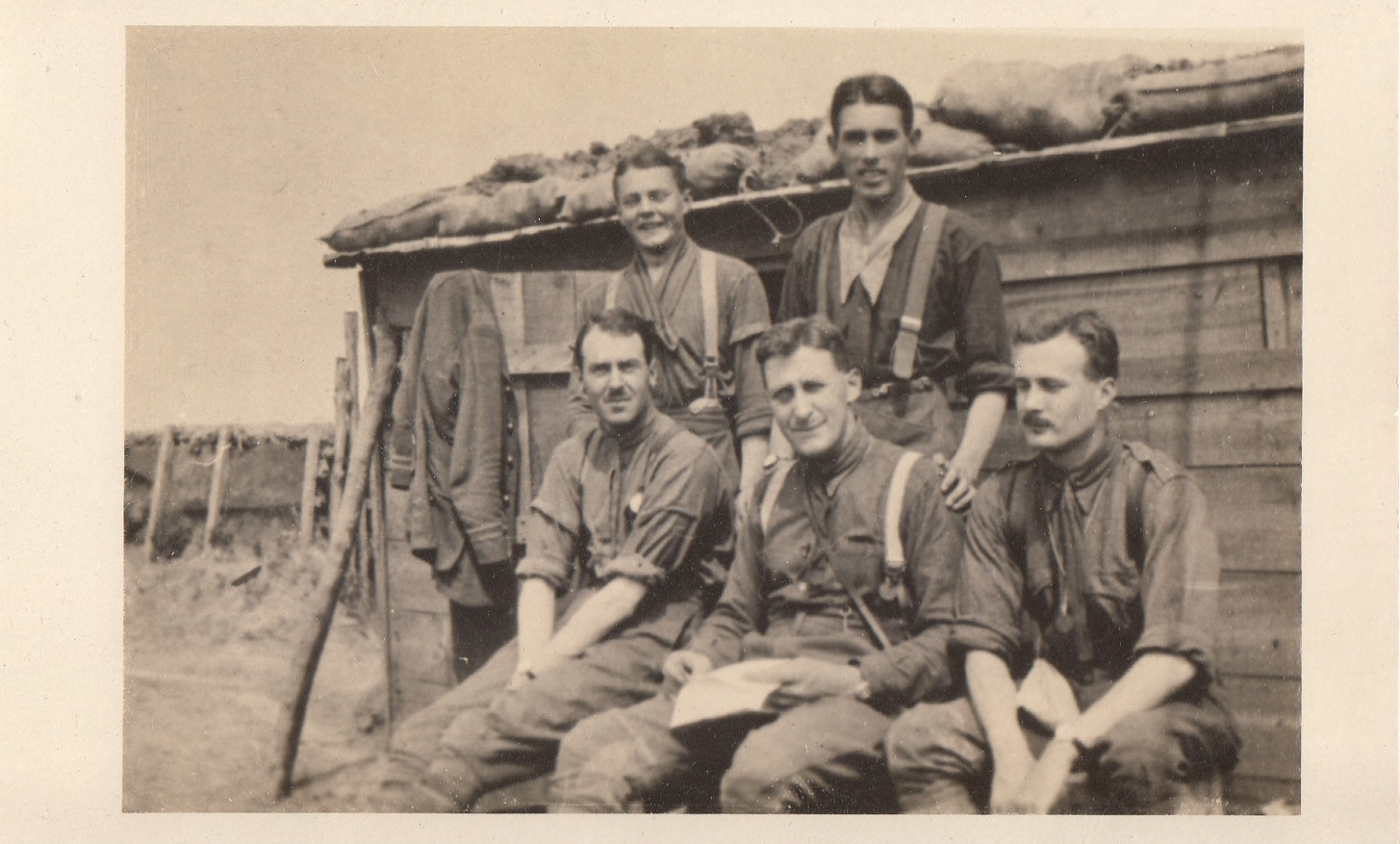
The photograph is taken outside one of the huts built at Houplines into the mud and timber barricades built over the low lying valley between Houplines and the German lines.

2nd Lieutenant Ray Dickinson, the son of Lady Dickinson, mentioned in the letter above was well known to both John and Frances Baber, as he had been brought up at 6 Phillimore Gardens, very near to 9 Phillimore Gardens where John's parents lived in Kensington.  Ray had volunteered for the battalion in the very first days of the war.  He was close to my grandmother and may have been her boyfriend.  She remained in contact with Ray's sisters long after Ray had been killed on the October 2nd 1915, by when he had become Captain in command of the Company. Ray was one of John's great friends in the battalion, and they planned to take their leaves together. He features in many of John's letters.

Lieutenant RS Savill would remain with the regiment for many years, becoming the Commanding Officer and returning the final Cadre to Regimental Headquarters on June 2nd 1919.  He commanded the regiment until 1922, and died in May 1967.  He was the only one of the officers in the photo to have survived the war.

2nd Lieutenant J. A. Green must have joined the QWR after October 31st 1914 but before they went up to the front on November 16th 1914, when he is listed with the others in Henriques account.

2nd Lieutenant F Barwell remained with the battalion into May 1916, after which he transferred into the Royal Flying Corps.  He met his death on April 26th 1917 over Beaumont Hamel in a dog fight where he was overwhelmed by about six enemy aircraft.

[1] Honourable Artillery Company. The oldest artillery unit in the British Army dating back to the days of Henry VIII. My grandfather Reginald Hancock served in the HAC in 1911 and 1912 while he trained at the Royal Veterinary College, at one point becoming a Lance Bombardier (unpaid.) He was to serve as a Veterinary Officer throughout World War I.
[2] John's mother added a note to the effect that Willcock had been awarded Chevalier of the Croix d'honneur. I have no further details about Harold Willcock and would be pleased to learn more if you are aware of any further information about him.
[3] Patterson Barton, John’s uncle a regular in the Indian Army, who shortly arrived in France with his battery on the 6th of November, but of course John was not at this point aware of it.
John had not been accepted for the Regulars when he had applied in about 1912, and this had upset him, so it was one up for him that he had beaten his uncle into action.
[4] Ray Dickinson.

Thursday, 13 November 2014

The General, a Lion, not a Donkey...

Figure 1. Major-General W.N. Congreve, V.C. and Major Paley,
Brigade Major, 18th Brigade in the Trenches at Houplines, Spring 1915.
It is General at the back of the photo. 


Throughout most of the later 20th Century it has become almost standard practice for most military historian's to accuse the British Armies First World War General's of living remotely from their men in chateau's far behind the lines and of having little idea of what their men were going through.

If that was ever indeed the case, the Queen's Westminster Rifles were extraordinarily lucky in having as their Brigadier, and then Divisional Commander, Walter Norris Congreve.  It is quite clear from the surviving accounts from the QWR that they did not regard Congreve as being in the slightest bit remote. And nobody could accuse him of never visiting the trenches.

The photograph above shows the general looking for all the world like an elderly batman standing in front of the parapet at Houplines in the Spring of 1915.

Major Henriques would write of him..

"General Congreve possessed that charateristic quality of a leader which makes each individual under him feel a personal link between himself and his commander.  Such a feeling begets trust, and General Congreve possessed the trust of his troops to a welcome degree.  His frequent visits to the trenches were welcomed, by company commanders and junior officers, as those of a helpful friend rather than a critic; and his advice, especially in the early days, and the manner in which it was given, created a spirit of confidence that was of the very greatest help to Territorial officers, who both realised their inexperience and felt their responsibilities.  Who will forget his cheery "good morning" to the men as he passed down the muddy trenches, or his habitual greeting "and how are the Westminsters this morning?"

"On one occasion, in January [1915], he narrowly escaped being shot by an enemy sniper, when visiting the trenches held by the Battalion, one of the sentries being shot through the head and killed instantly while pointing out to him some of the danger spots in the German lines." [1]

On the 29th April 1915 Major-General W.N. Congreve would be promoted to command the 6th Division.

During the Boer War Congreve had been awarded the Victoria Cross for his part in rescuing the guns at the Battle of Colenso. With several other men he had crossed over 500 yards of bullet swept flat ground with a scratch team of horses and a limber in an attempt to retrieve several field guns who had opened fire too close to the Boer lines. Within a very short time the crews were all dead or wounded. Congreve was a subaltern with the Rifle Brigade. Amongst the other men to go forward was the son of Lord Roberts. Roberts was shot and wounded. Seeing Roberts lying in the line of fire Congreve went out into the direct sight of the Boers and managed to retrieve Roberts. Whilst making his dash forwards Congreve was shot through the leg and foot, and several other Boer bullets passed close enough to his body to tear holes in his uniform.
 
Congreve would later go on to command the XIII Corps and to mount one of the very few successful attacks during the Battle of the Somme when the 18th and 30th Divisions were the only ones to take all their objectives on 1 July.  Congreve soon added to his reputation through his advocacy of a night advance and dawn assault.  This tactic, which returned surprise to the operational agenda, was successfully carried out on 14 July at Delville Wood.  Congreve congratulated himself in his diary:

Haig came to see me and was very complimentary and grateful for our success yesterday, and indeed it was a good operation.  I do not think so great a force was ever before got into position within 300 yards of an active enemy for a dawn attack, and our losses before the advance were very small.  Our advance was over 1,400 yards of open ground.  The arrangements of the Brigade staffs, the discipline of the battalions and the effectiveness of our artillery are the causes of our success.  I think it will be a text book operation.  I am told it is the most successful of the war and I planned it![2]

The Battle of Delville Wood is remembered today for the appalling losses suffered by the South African troops involved in attacks later in the day. However the initial attack had been well planned, but as was to be the case until the Battle of Amiens in 1918 the Germans were able to move up reinforcements faster than the British could exploit the breakthrough that Congreve and his men had made.

In many ways Congreve's tactics are the precede the very similar tactics developed later so successfully by the Australia and Canadian Generals.

His son Major William La Touche ‘Billy’ Congreve, was killed on the Somme on 20 July 1916 leading from the front and then going out into No Man's Land to bring his wounded men in.  William joined his father in winning a VC.  However for the General the strain was to become almost unbearable and in August 1916 he caught cholera.

Eventually Congreve's habit of visiting the Front would catch up with him.  During June 1917, he had his left hand  blown off by a German 5.9” shell near Vimy Ridge.  He was the only corps commander to be wounded during the war.

Congreve was an asthmatic who suffered from bronchitis. Although he did return to command during the March 1918 retreat, he had by that time become exhausted and his troops suffered very badly from his decision to try to hold the line.

After the war he would be made Governor of Malta where he died in 1927.


Figure 2.  The Monument to Major-General W.N. Congreve on Malta.

Something of his care for his men comes over in the following quotation from a letter he wrote to his son.

‘I don’t feel I can ever make a general,’ he wrote to his son on 5 April 1916, ‘for I cannot face having men killed in the ruthless way generals must do ...’[3]


[1] Henriques, Major J.Q. The War History of the First Battalion Queen's Westminster Rifles, 1914-1918. Page 50 and 51.
[2] From the Centre for First World War Studies "Lions Led by Donkeys " by John Bourne http://www.warstudies.bham.ac.uk/firstworldwar/research/donkey/congreve.shtml
This article is a very good one about Congreve and goes into a great deal about his early career. I thoroughly recommend it to you if you are interested in Congreves life.
[3] John Bourne Centre for First World War Studies.

Sunday, 26 September 2010

The Fulton family and volunteer rifle tradition in the Queen's Westminster Rifles

Figure 1. Sergeant A. G. Fulton. Photo taken by Lt. J.B.Baber.at Edmead's Farm
near Houplines, probably taken in May 1915. [1]

Sergeant Arthur Fulton was one of the stalwarts of the Queen's Westminster Rifles. An extremely able marksman, Fulton had been the King's Cup winner at Bisley in 1912, and would go on not only to survive the war, but also to win the Kings Cup for a second time in 1924.

Marksmanship was a family tradition.  Fulton's father, Sergeant G. E. Fulton had won the Queen's Cup in 1888 when serving with the Wimbledon Volunteers.


Figure 2. Sergeant Fulton from Middlesex.

George Fulton had started his shooting career in the Wimbledon Rifle Volunteers by 1881 and had won the Queen's  Prize in 1888, and the Grand Aggregate in 1890 and the St. George's in 1896 and 1900.  He went on to found his  own gun smithing company in about 1895.  At first this business operated out of Wandsworth before moving to Staines where there was a large range at the time. 

The National Rifle Association had moved its headquarters to Bisley Camp in 1890, and Staines was conveniently placed in relation to the ranges there and at Bisley. Fulton set up his business in a sectional wooden building equipped with verandas that was moved to the Bisley ranges from Wimbledon and which survives today [2]


Figure 3. Rifle Volunteers at Wimbledon 
(Please click on picture for larger image.)

George Fulton must have been one of the many young men who joined the Volunteer Rifles in the 1870's. The rise of Napoleon III's France and steam ships had made many in Britain concerned least an invasion be mounted on our shores. Any potential enemy could now arrive regardless of the wind.
The 1870 Franco Prussian War had shown just how vulnerable we had become with the advent of large European conscript armies just a few hours steaming from our coast.


Figure 4. South London Rifle Club at Nunhead Ranges 1879.
(Please click on image for larger version.) 
Private Low and Major Starkey of the QWR
are amongst the competitors.

This Volunteer movement has particularly popular in the Wimbledon, Peckham and Rye area and was open both to gentlemen volunteers and well as tradesmen like Fulton.  As can be seen from the photo above both gentlemen and ordinary men were able to mix at these events, which was not the case at most other times.  For many young men it represented the best way to get a holiday. The camps became great social events.

George Fulton's great ability in shooting must have attracted the attention of the Queen's Westminster Rifles, who were one of the keenest of these Volunteer Regiments, and they appear to have managed to lure George Fulton away by 1889 to join the unit. He was then enabled to set up his own business working to modify and improve rifles for competition.

"Staines, Dec.29.
15 November 1889
THE VOLUNTEERS."

"It was yesterday officially announced that Sergeant G.E. Fulton, of the Queen's Westminster Volunteers, the winner of the Queen's prize of £250 and the gold medal and gold badge of the National Rifle Association at Wimbledon last year, has carried off the championship and gold jewel of the North London Rifle Club this season with the best score ever recorded in the annals of rifle shooting under the same conditions. His aggregate of eight "shoots" at 200, 500, and 600 yards and of four at 800 and 900 yards with the Government Martini-Henry rifle totals exactly 1,100 points. Captain Cowan, of the Royal Engineers, is second with 1,088, and Corporal Leghorn, of the London Scottish, third with 1,073."[3]

George Fulton was a widely respected authority on rifles. In 1905 he wrote the following letter to the Times newspaper criticising the new service rifle then coming into service. 

"The Times
 
5 January 1905
TO THE EDITOR OF THE TIMES.
THE NEW SHORT RIFLE.


Sir, In your issues of the 19th and 22nd there appeared some correspondence respecting the new short rifle. I am very sorry not to have been aware of this at the time, but hope that you will allow me, though late, a little space for a few remarks.
I have tried several of these rifles up to 600 yards, and one at 800, and cannot understand how the Hythe School find that it shoots closer than the long rifle. My experience is rather the reverse.
For so short a weapon it is ill-balanced and top heavy, and so is ill adapted for swift alignment of sights necessary in quick but accurate shooting at short range, which, I believe, the rifle, strangely enough, is supposed to be designed for.
They have bored holes in the butt, under heel plate, to reduce weight a trifle. This only makes balance worse, and a badly-balanced rifle or gun always handles heavily. The small shallow open notch of backsight and the large projections of the open topped hood on either side of foresight also hinder quick off-hand shooting. A large deep notch is the best for quick sighting, especially in an indifferent light, and a foresight then stands conspicuously alone, as on the long rifle.
I make these remarks as quick shooting at short range has lately been so strongly recommended by the military authorities.
Your correspondents consider the sights of the new rifle superior. In finish they undoubtedly are; but a traversing wind-gauge sight is fanciful, not practical. All very well for making minute alterations of the sight scale, when the wind is being judged by the state of the flags on a range; but I have often asked those who have seen service of what use such sights would be, and the answer is what I expected.
A good, well-finished tangent sight, with a large sight notch in leaf-cap for short ranges, and a very small narrow one on sliding bar, just sufficient to take in a moderate amount of foresight, for more deliberate shooting and medium and long ranges, the tip of sight level, with shoulders of notch working the ground line of objects aimed at, on the old approved method, would be more to the purpose than the new sight, with only one notch, which neither suits one purpose nor the other. Another objection to the short rifle is the greater flash it makes in the dusk.
The safety catch is not so handy, or so readily moved, as another form that has long been adapted to this action by a large firm of rifle manufacturers.
In conclusion, the authorities would have acted wisely in issuing a few hundred of these short rifles for trial by the best known all-round shots in the Volunteer Forces.
I am, Sir, your obedient servant,
G.E. FULTON."
[4]

The rifle George Fulton was referring to became the Short Magazine Lee-Enfield Mk I, and was to become one of the most important rifles in military history, serving throughout the First World War and on into the Second World War.  Some remain in service in 2010 in India with the police force.

The Fulton's would go on to convert many of these rifles for target shooting. The main areas for improving were the screws that held the barrel to the wooden housing. With time and if maintenance was not regularly undertaken the screws would come loose and the wood would shrink, causing the barrel to move in relation to the wooden forward parts. This caused the rifle to loose accuracy. The Fulton's work on making it more accurate caused the Rifle Association to make the Bull's in targets smaller twice during the inter war period.

George Fulton was not unsurprisingly appointed the QWR's Armourer Sergeant. 

During 1905 he was part of a team lead by Captain Montagu De Mancha Shattock who beat an American team from the Seventh National Guard on July 6th and 7th at Bisley by 10 points.  Corporal Short, a National Guardsman hit the bulls eye with one of his shots, only to discover that it was on the adjacent target. This lost them the competition.

Between September 24th and October 7th 1906 a return match set up by Sir Howard Vincent, a wealthy former commander of the QWR was shot for at the Sir Howard Vincent Anglo-American Challenge Shield at Creedmoor near New York. An article in the New York Times contains the following paragraphs

"The make up of the English team this year is nearly the same as it was last.  Armourer Sergt. Fulton who has been in the regiment since 1881, is the crack shot.  His son A.G. Fulton, is nearly as good, having scored 261, against his father's 262 in the contest with the Seventh.  The father has the great distinction of having won the King's Cup twice.  His son missed it once only by a very narrow margin."

"From the accounts of the contest brought home by the Seventh's representatives, Armorer Sergt. Fulton is a most picturesque character. He is a gunsmith by trade, and is exceedingly quiet and unassuming.  At any sort of social gathering he never says a word unless it is tricked out of him.  Though he is a gunsmith and some of his fellows in the regiment come from the most aristocratic sires in Britain, the old Sergeant is much sought after." [5]

In the return match George Fulton does not appear to have taken place. Corporal Arthur Fulton, was one of the six in the team, and Rifleman Roche also shot in the match as one of two reserves. Sadly, on this occasion they were beaten by the American team. [6]

The importance to the Regiment of the Fulton's is hard to overstate. As soon as the Regiment mobilised in August 1914 they set to work to bring the rifles and marksmen skills to as high a level as possible.

The regiment had not been equipped with the Short Lee Enfield used by the Regular Army in 1914. These were in short supply, and reserved for Kitchener's new army.

The QWR were not expected to be sent overseas as early as they were.  As late as 29th September 1914 Lord Kitchener who inspected the unit at Gorhambury Park had told them "Not a man will leave until your second battalions are fully equipped and ready to take your place." [7]

Figure 5. Long Charger-Loading Magazine Lee-Enfield.[8]

On the 31st of October 1914, having been quite unexpectedly informed that the regiment was being sent to France, on the previous day, the 30th of October, it was then issued with an entirely new type of rifle, that they had not previously had any experience on. The rifle was one of the alternatives to the Short Lee-Enfield that had been rejected for regular service.

This was necessary because the one they had been training could not take the Mark VII cartridge being issued in France, which the Longer Charger rifle fortunately could.

Sergeant Arthur Fulton and his father George had suddenly to test and adjust approximately 800 new issued  rifles, working along with the other best regimental shots. 

The men themselves had no opportunity to test or familiarise themselves with the new rifles before they set off for France. Fortunately the main difference to the ones they had trained on, was in the sights and breach. These rifles remained in use until after the actions at Bellewaarde in 1915 when so many rifles were recovered from casualties in other units that it was possible to provide the battalion with the standard rifle used by the Regular units.


Figure 6. Private of the QWR equipped with the Long Charger
Lee Enfield during the winter of 1914-15 at Houplines. [photo by Lt J B Baber] 

Possibly because 2nd Lt Baber was one of the least experienced, and probably also the youngest officer, he was appointed as Machine-Gun Section commander, with Sergeant Arthur Fulton as his second in command. I expect that it was a great relief to Baber to have such an able man in day to day command of his unit.

The Lance Corporal was R. de R. Roche, another very experienced soldier who had served in South Africa during the Boer War as also in the machine gun section. He was George Fulton's brother in law, and a very fine rifle and pistol shot.

Sergeant Arthur Fulton displayed his skills as a marksman when he made a very remarkable shot. Spotting a German officer sitting in a window of a house in the village of Frelinghein well behind the lines, he estimated the range at 800 yards, and was able to pick the officer off with his first round. [9]

During November 1914 and into 1915 the Regiment suffered from having very little artillery support due to the shell shortage, and were suffering from German observation and snipers, so this success must have been a great morale booster.

Arthur Fulton went on to become well known in the 1918 to 1939 period for the unique distinction of being the only man to win the Sovereign's Prize three times, he has also won the King's Silver Medal three times and holds the record number of King's and Queen's Final Badges.

For many years' from 1920 until the advent of the P14 rifle in 1935, the S.M.L.E. was the only weapon permitted for the S.R. shooting under the N.R.A. Rules, and in the early days of that rifle's history the continuance of rifle shooting as a competitive sport undoubtedly hung in the balance. It was at this time that the pioneering work done by Arthur Fulton at Woolwich and in his spare time on privately-owned rifles which resulted in the process known as "packing" which did a great deal to bring about some sort of "levelling-up" of the standard of shooting obtained from these otherwise extremely inaccurate weapons.
By careful controlling the barrel vibrations, and skilfully adjusting the "packing" material so as to stiffen the otherwise weak barrel and action without restricting the expansion of the former, an extremely high degree of accuracy was obtained which enabled the size of the bullseye at all ranges to be reduced twice during this period.

Arthur Fulton who had a son, who became a noted shot in the 1950's, and a daughter was awarded the M.B.E. in the 1959 New Year Honours List for his services to rifle shooting.

A film from 1926 is held by British Pathe which shows the family of Sergeant Fulton called"Camera Interviews - Sgt. Fulton - The Famous Rifle Shot." which contains the following stills.


Figure 7. Sergeant George Fulton in 1926 (From British Pathe)

If you are connected to the Fulton family, or are able to provide any additional information on their activities with the QWR, I would be very interested to hear from you.


Figure 8. Sergeant Arthur Fulton with his dog Sailor in 1926
(From British Pathe)


[1] Edmead's Farm north east of Houplines village.  The farm formed part of the front line, but was totally destroyed by later battles in the area. It's location was at approximately 50 degrees 41' 52.09" N 2 degrees 55' 34.67"E. The site is just to the south west of the roundabout where the N58 from Belgium comes into France and joins the D945.
[2] G. E. Fulton & Son, registered gunsmiths.  See http://www.fultonsofbisley.com/history.htm
[3] from http://freepages.genealogy.rootsweb.ancestry.com/~fultondata/Biog01.htm
[4] from http://freepages.genealogy.rootsweb.ancestry.com/~fultondata/Biog01.htm.  See also http://www.milsurps.com/showthread.php?t=13678 for a very good article on the technical aspect of Fulton's work.

[5] The full article about this competition in New York can be found in the New York Times archive at http://query.nytimes.com/mem/archive-free/pdf?res=F20C11F6355A12738DDDAC0994DF405B868CF1D3
[6] Report from New York Times, 6th October 1906, available at http://query.nytimes.com/mem/archive-free/pdf?res=F20E13F73A5E12738DDDAA0894D8415B868CF1D3[6] Major J.Q, Henriques, "The War History of the First Battalion Queen's Westminster Rifles, 1914-1918." page 10.
[7] Photo copied from Arundel Militaria website, which has several other pictures of a surviving example. http://www.deactivated-guns.co.uk/deactivated-guns/allied-deactivated-guns/super-rare-wwi-charger-loading-lee-enfield-rifle/prod_679.html
[8] Henriques, "The War History" page 28.